ADDIS ABABA, Ethiopia
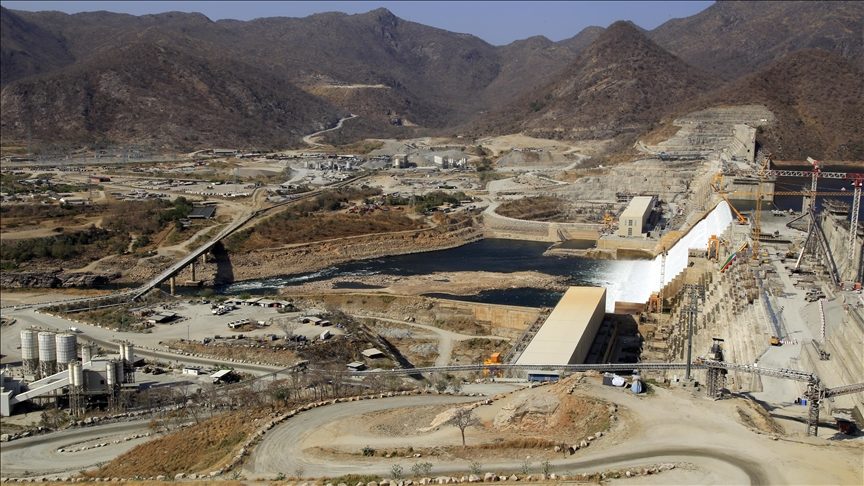
The Grand Ethiopian Renaissance Dam (GERD), Africa’s largest hydroelectric project, rises on the Blue Nile about 40 kilometers (28 miles) from the Sudanese border in Guba, which is around 580 kilometers (360 miles) from Addis Ababa.
The dam is designed to generate over 5,150 megawatts, transforming Ethiopia’s power supply and enabling electricity exports across the region.
The idea of a dam on the Blue Nile dates back to pre-1964 studies by US engineers, but regional politics have long shaped the river’s governance.
The dispute between Ethiopia and downstream countries, particularly Egypt, began decades ago: in an exchange of letters with Egypt’s semi-independent administration, the British government recognized Egypt’s “natural and historical right to the waters of the Nile” and agreed that upstream developments should “observe” these rights—a stance Ethiopia has described as a “colonial imposition.”
Later, Egypt and Sudan signed a bilateral agreement allocating all of the river’s water between the two countries, effectively limiting upstream development for decades. Ethiopia, as an upstream nation, viewed these agreements as restricting its sovereign rights to develop water resources for domestic use.
Political upheaval, wars, and underdevelopment delayed dam projects in Ethiopia until the early 2000s, when the country revived plans as part of a broader effort to harness its rivers and expand electricity access.
The construction of GERD became a national priority under the late Prime Minister Meles Zenawi in 2011, a period coinciding with regional unrest linked to the Arab Spring.
Here is a concise timeline outlining the start of actual dam construction and its completion:
March 2011 – Ethiopia publicly announces plans for a massive new dam, initially called the Millennium Dam, with a budget of around $4.8 billion. Italian contractor Salini Impregilo is awarded the project.
April 2011 – Prime Minister Meles Zenawi lays the cornerstone, renaming the project the Grand Ethiopian Renaissance Dam (GERD).
May 2011- Ethiopia diverts the Blue Nile to allow construction, drawing criticism from Egypt, which warns of potential impacts on its water supply.
May 2012 – Ethiopia, Egypt, and Sudan agree to form an International Panel of Experts (IPoE) to study the dam’s impact.
May 2013 – Leaked findings from the IPoE highlight the need for further environmental and safety studies. Disputes sharpen between Egypt and Ethiopia over water security.
March 2015 – Ethiopia, Egypt, and Sudan sign a Declaration of Principles in Khartoum, pledging cooperation and peaceful settlement of disputes over GERD.
2017 – Negotiations stall as Egypt and Ethiopia clash over technical studies and data-sharing on the dam’s operation.
November 2019 – US and World Bank officials begin mediating talks in Washington, DC, but no binding agreement is reached.
July 2020 – Ethiopia announces the first filling of the reservoir during heavy rains. Egypt and Sudan protest and bring the issue before the UN Security Council.
April 2021 – Talks resume but fail to resolve disagreements over binding water release guarantees.
July 2021 – Ethiopia completes the second filling of the dam, further straining ties with Egypt and Sudan.
February 2022 – The first turbine begins producing electricity, supplying 375 MW to Ethiopia’s grid.
August 2022 – A second turbine becomes operational, and Ethiopia confirms a third filling of the reservoir.
September 2023 – Ethiopia carries out the fourth filling, raising the water level to around 625 meters. Egypt lodges formal protests.
October 2024 – Ethiopia declares the fifth and final filling completed, achieving full reservoir capacity. Talks with Egypt and Sudan remain stalled.
July 2025 – Authorities announce construction is finished and plan an official inauguration.
September 2025 – Prime Minister Ably Ahmed inaugurates GERD, marking full operation with a total capacity of around 5,150 MW, despite unresolved disputes with Egypt and Sudan.