ISTANBUL
The roots of the current conflict in Ethiopia lie in the past, scholar and former Sudanese Ambassador to Ethiopia Elsadig Elfakih said Friday.
“There are cultural, traditional, ethnic, territorial reasons” behind the current conflict which date back decades, he said.
Elfakih delivered a talk on the ongoing conflict in the Tigray region at the Istanbul-based Center for Islam and Global Affairs think tank where he currently serves as Senior Research Fellow.
“Ethiopia is unique in many ways be it culture, history, tradition, its geography,” he said.
“To understand what is happening in the African country now, we have to have a strong understanding of the country’s background and state-building.”
Elfakih, who teaches at Sakarya University, said the Tigray region, where the latest conflict has consumed thousands of lives, was annexed in 1941 by Ethiopia which was under Italian rule.
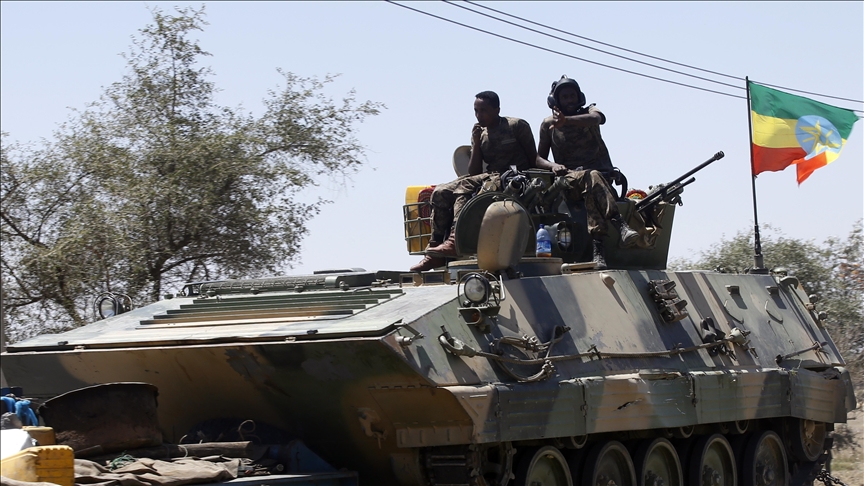
War broke out last year between the government and forces of the Tigray People’s Liberation Front (TPLF), which has left thousands dead and many displaced.
Prime Minister Abiy Ahmed ordered a military offensive against Tigrayan forces on Nov. 4, 2020, after accusing the group of attacking a military base.
TPLF fighters advanced to within 200 kilometers (124 miles) of Addis Ababa. But since Abiy’s deployment, according to government claims, many strategic areas and major towns have been liberated.
It includes the entire Afar regional state, where the TPLF made incursions in a bid to cut off Ethiopia’s main arterial road to Djibouti, through which the majority of the Horn of Africa nation’s import-export passes.
Other liberated areas in the Amhara regional state include the UNESCO-registered world heritage town of Lalibella, Gashena, Showa Robit, Debre Sina, Kemissie, Dessie and Kombolcha.
The TPLF, which governed the country for nearly three decades before being deposed in 2018, however, termed the development a strategic retreat.
“We left North Shoa, Kombolcha, and Dessie as part of our plan,” a TPLF spokesperson said on Twitter. “Things are going according to our plan. The rest is just circus.”
Ethiopia, said Elfakih, has been a free country all its history.
“It is the only country in Africa which was not occupied by the colonialists.”
He said the main conflict has been between Tigray and the Amhara regional state.
“Much of what is making news in the western part of Ethiopia was not part of Ethiopia until 1903 which is Benishangul-Gumuz region where lake Tana exists besides the Renaissance dam which is making a lot of conflict among Ethiopia, Sudan and Egypt,” he said.
Besides the conflict concerning the dam, said Elfakih, historic differences between Tigray and Amhara are reasons for the ongoing conflict.
“In 1974, Tigray established their first movement for liberation from Ethiopia,” he said.
The date “is very important” for Muslims of the country.
Elfakih said the official count says Muslims constitute one-third of the total 115 million population.
“But there is no count done on religious identity,” he said, adding Muslims are spread across all ethnicities and regions.
“When communists came to power, they tried to limit the powers of the Tahweedi Church,” he said, referring to the Orthodox Church of Christians which used Arabic for prayers until 1959.
“Muslims for the first time got some opening during this time,” he said, adding Muslims are considered guests in the country “even if they are part of all groups in Ethiopia.”
“They were not treated equally especially in public services until 1974.”