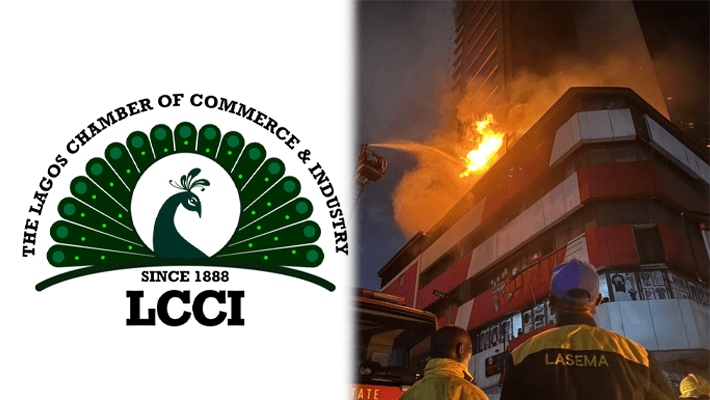
Lagos Chamber of Commerce and Industry (LCCI) has outlined strategic measures to prevent market fires, safeguard enterprises, and sustain economic activities following the fire at Great Niger Insurance House, Lagos Island.
The blaze, which occurred between Wednesday and Thursday, razed the building on Martins Street, causing losses worth millions of naira and affecting numerous small and medium enterprises (SMEs).
The director-general of LCCI, Chinyere Almona, in an interview with journalists on Saturday in Lagos, said the incident highlighted the vulnerability of market-based enterprises, which form the backbone of Lagos’ commercial ecosystem.
She noted that beyond the immediate destruction of goods and infrastructure, such incidents raised critical concerns about business continuity, safety preparedness, investor confidence and the resilience of Nigeria’s trading environments.
Ms Almona added that with insurance penetration among Nigerian SMEs estimated to be below five per cent, most affected operators lacked the financial buffers required to restart operations quickly.
“This often leads to prolonged downtime, loss of income and potential exit from the market.
“Beyond individual businesses, such incidents disrupt supply chains, weaken customer confidence and reduce overall commercial activity in affected areas, highlighting the fragility of business continuity planning among market-based enterprises,” she said.
According to her, the recurrent spread of fires in major markets exposes critical infrastructure gaps that require urgent attention.
She said many markets lacked functional fire hydrants, reliable water supply and onsite firefighting equipment, forcing responders to rely on external resources and delaying containment.
Ms Almona added that overcrowded layouts, narrow pathways and unauthorised structural extensions further accelerated fire spread and hindered emergency access.
“Addressing these gaps demands a comprehensive redesign of market infrastructure that prioritises safety, enforces building codes and integrates fire prevention into market planning and operations,” she said.
The director-general stressed that improving safety and preparedness in markets required a deliberate shift from reactive responses to preventive and structured risk management.
She said this included the installation of functional fire detection and suppression systems such as smoke alarms, fire extinguishers, sprinklers and clearly marked emergency exits.
“Equally important is routine fire safety education for traders, including basic firefighting skills and evacuation procedures.
“Electrical safety standards must also be strictly enforced through regular inspections, as faulty wiring remains a leading cause of market fires, while clearly demarcated emergency access routes should be maintained.
“When infrastructure upgrades are complemented by continuous awareness and enforcement, the scale of losses during fire incidents can be significantly reduced,” she said.
Ms Almona also called for effective coordination between government agencies and market operators to ensure proactive fire risk management.
She said this could be achieved through the establishment of permanent joint safety committees involving market associations, the Lagos State Fire Service, emergency management agencies and local authorities.
She added that regular engagement forums and joint simulation exercises would improve preparedness and response efficiency.
“Clear communication channels, using digital platforms and market leadership structures, should be institutionalised for early warnings, compliance updates and emergency alerts.
“Furthermore, collaborative data sharing on market layouts, trader registers and risk assessments would enable faster and more informed emergency interventions.
“LCCI reiterates that safeguarding markets is not only a safety imperative but also an economic necessity.
“Protecting SMEs through improved infrastructure, coordinated governance and strategic partnerships is essential to sustaining Lagos’ role as Nigeria’s foremost commercial hub and ensuring inclusive economic growth,” she said.
(NAN)