
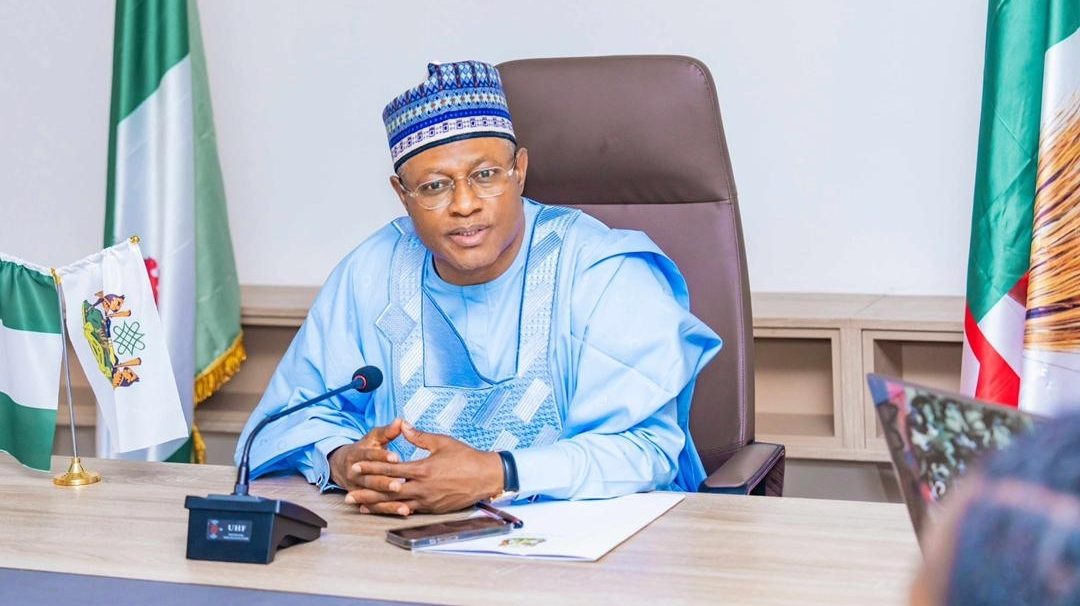
Governor Uba Sani has said that the central focus of his electrification drive is to boost economic activities and strengthen small and medium enterprises.
He disclosed this at the flag-off of phase one of the distribution of 600 transformers and accessories across the 23 local governments and the deployment of 10,000 solar-powered street lights.
Speaking at the ceremony, the governor said, ‘’We are enabling welders, tailors, cold-room operators, ICT hubs, and manufacturers to operate with dignity and predictability.
‘’We are sending a clear message that access to energy must no longer be the privilege of a few urban centres but the right of every community.
The Kaduna governor added that electricity was not a luxury but the bloodstream of modern society.
The governor pointed out that electricity powers hospitals and preserves vaccines, lights classrooms and expands the horizons of children, as well as ‘’drives our industries, irrigates our farms, and sustains the small businesses that form the backbone of our economy”.
According to the governor, without reliable power, development is stunted, security is weakened, and opportunity is constrained.
Mr Sani disclosed that his administration had completed some abandoned power projects and initiated new ones since he assumed office close to three years ago.
‘’In the health sector, under the previously stalled Indian-Exim Bank initiative, we completed solar mini-grid installations in 190 out of 225 Primary Health Care Centres, delivering 1.35 megawatts of clean energy.
‘’We restored 32 abandoned systems; 21 in PHCs and 11 in General Hospitals. The result has been tangible: improved service delivery and a measurable reduction in maternal and child mortality,’’ he added.
The governor also said that his administration has ‘’completed the long-abandoned 2x60MVA, 132/33kV Substation at the Green Economic Zone in Maraban Jos”.
He argued that the substation is more than infrastructure, adding that it is an industrial catalyst which ‘’unlocks investment potential, stimulates manufacturing, and positions Kaduna as a competitive economic hub”.
“In Kubau Local Government Area, the Damau solar model, delivering 100 kilowatts, has ended a decade of darkness for 450 households. Additional distributed generation projects totalling 1,694 kilowatts are underway in Chara, Gidan Kundi, Gora, and Hawan Mai Mashi,’’ he promised.
Mr Sani also listed the electricity projects that his government has executed in the three senatorial districts since he assumed office two and half years ago.
“In Zone one, we rehabilitated distribution networks stretching from Maraban Kubau to Kubau, from Makarfi through Tashan Icce and Tashan Yari and from Lere to Saminaka and Unguwan Bawa,’’ he said.
According to the governor, Zaria, Sabon-Gari, and Kudan towns in zone one have each benefited from multiple transformer installations.
‘’In zone two, several transformer installations and network rehabilitations have strengthened supply resilience across multiple communities,’’ he added.
The governor disclosed that his administration had rehabilitated critical lines from Kagarko Junction to Manchok in zone three.
He equally said that thr Kaduna state government has restored high and low-tension networks in Unguwan Magata and Unguwan Doh; intervened in Ramai Gida and Jaba local government.
According to the governor, he has extended rehabilitation from Jagindi Junction to Gwado-Gwado, restored the Gada-Biyu to Kogun River corridor spanning 69 kilometres.
His administration has also ‘’completed major works along the Tafa-Jere-Kagarko high-tension line with associated transformers and accessories’’ in zone three.
The governor also disclosed that a landmark memorandum of understanding was signed on October 22, 2025, with the Rural Electrification Agency, adding that his administration is advancing a 1.5-megawatt project for Kaduna Polytechnic and an eight-megawatt allocation for Ahmadu Bello University, Zaria.
‘’We are developing urban generation projects, including a 2-megawatt initiative in the TRAPCO community,’’ he said. “We are also planning two megawatts for Shika and four megawatts in Makarfi to boost local manufacturing.’’



