
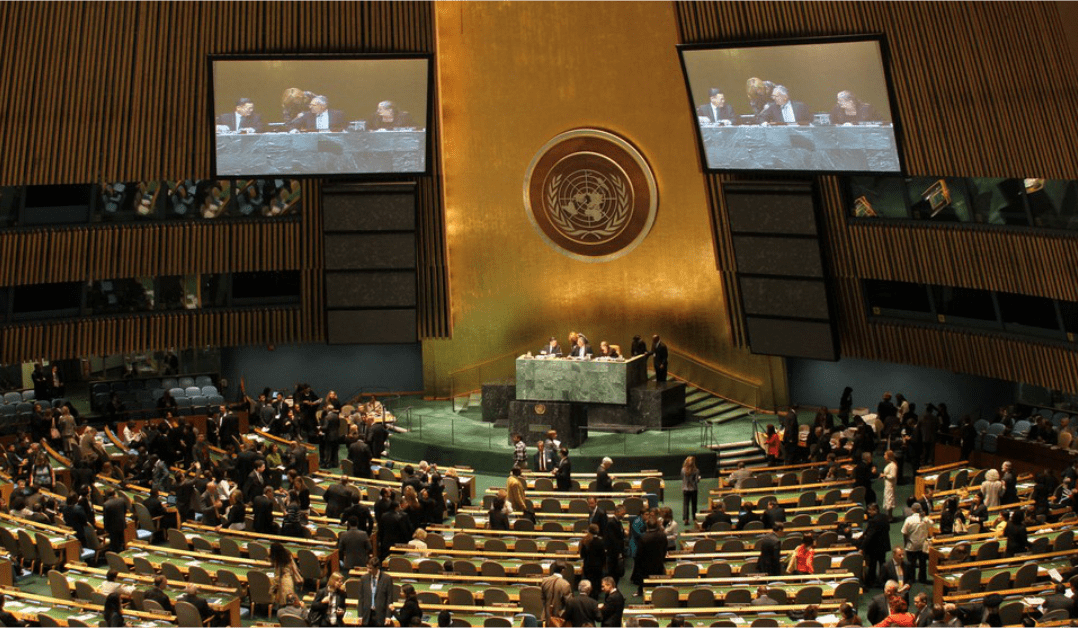
The resolution proposed by Ghana was passed, with 123 countries voting in favour of the declaration.
The adoption of a United Nations resolution recognising the transatlantic slave trade as the gravest crime against humanity by the majority of members and its opposition by three countries have sparked debate.
The resolution proposed by Ghana was passed in the United Nations General Assembly Hall on Wednesday, with 123 countries voting in favour of the declaration, which also urged UN members to apologise for the atrocities and to contribute funds for reparations.
Despite most countries voting for or completely abstaining, only the United States, the State of Israel, and Argentina voted against the resolution, a decision that generated debates on social media.
Observers argued that the NO vote, especially by the United States, was not surprising, given the ‘anti-wokeness’ policies that President Donald Trump has embarked on in his first and second terms at the White House. The United States’ close allies, both Argentina and Israel, have recently been voting with Washington.
Since his return to office last year, Mr Trump has signed a series of executive orders that critics said are meant to ‘whitewash’ the United States’ slavery history, including one proclamation that directed the removal of slavery exhibits from the President’s House Site in Philadelphia.
Reports noted some of those exhibits were related to the nine people enslaved by the first president of the United States, George Washington, while living in Philadelphia. In February, a judge ordered the Trump administration to return the exhibits.
Other policies include the reinstatement of controversial monuments and historical markers of figures involved in the transatlantic slave trade and the cancellation of federal funds to institutions focusing on slavery.
Meanwhile, 52 countries, mostly European nations, abstained from voting on the resolution. These countries included Albania, Andorra, Armenia, Australia, Austria, Belgium, Bosnia and Herzegovina, Bulgaria, Cambodia, Canada, Croatia, Cyprus, Czechia, Denmark, Estonia, Fiji, Finland, France, Georgia, and Germany.
Others were Greece, Hungary, Iceland, Ireland, Japan, Italy, Latvia, Liechtenstein, Lithuania, Luxembourg, Malta, Monaco, Montenegro, Netherlands, New Zealand, North Macedonia, Norway, Oman, Palau, Paraguay, Poland, Portugal, and Romania.
San Marino, Slovenia, Slovakia, Spain, Sweden, Switzerland, Ukraine, the Republic of Moldova, and the United Kingdom also abstained.
Reacting to the vote distribution, one X user, @sleekcliq, from South Africa, commented, “The U.S.A., Israel, and Argentina voted against. The whole of Europe abstained, mmmh…Africa, you are on your own!”
@tairusi from Kenya said, “We already know Israel has the U.S.A. on a chokehold and might be returning a small favour here to the U.S.A., but I don’t know what is ailing Argentina.”
In his own submission, @alpha_the_dev, who is based in Nigeria, pointed out the overwhelming support the resolution garnered from Islamic countries that he said Christians have negative opinions about.
“Iran, Iraq, Saudi Arabia, all those countries that Christians don’t like because they’re the ‘Children of Ishmael’ voted to condemn the slave trade, but the Christ-like U.S.A. and the people of God, Israel, and Puppet, Argentina, think that the slave trade was a cool thing,” he stated.
Meanwhile, @dirk_bez, a white South African, condemned the resolution, stating, “Africans caught and sold other Africans. Arabs caught more Slavic people than any other race in the world; that’s literally how the world ‘slave’ came to be. England introduced the abolishment of slavery over the colonies, and the rest of Europe adopted this in principle.”



