
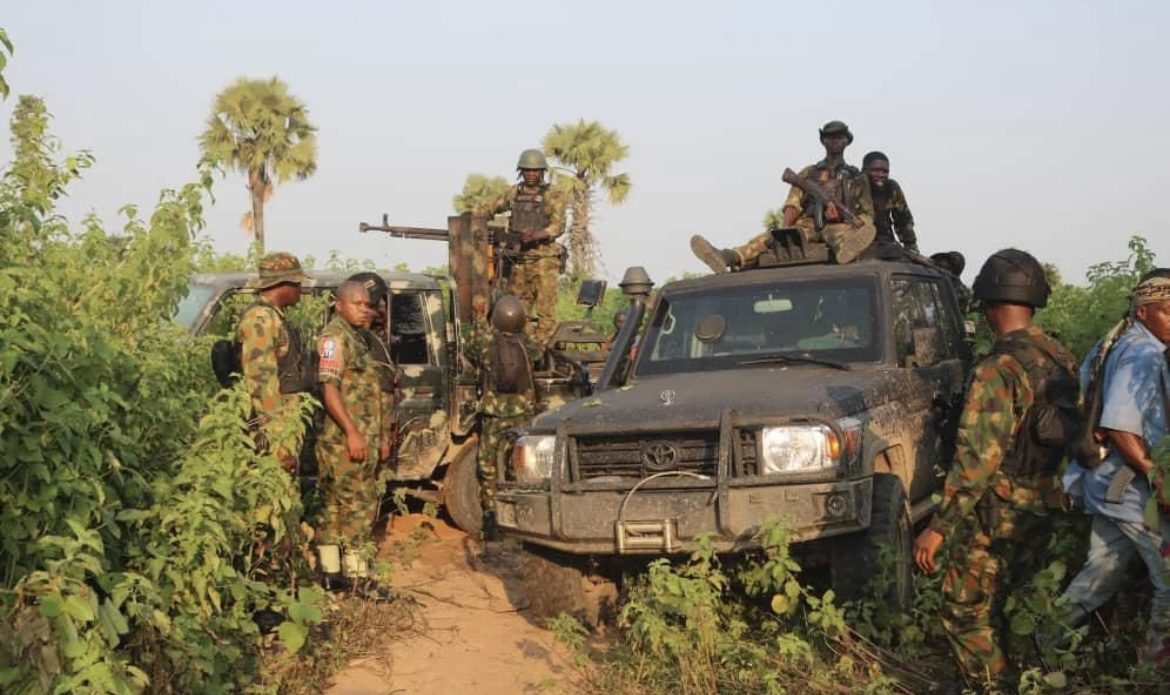
Bola Tinubu, in March 2021, called on then-President Muhammadu Buhari to authorise the immediate recruitment of up to 50 million young Nigerians into the Nigerian Army, saying such action would overwhelm the ragtag groups of insurgents and bandits terrorising the country across multiple flanks. The former Lagos governor, several hours later, walked back his statement, saying it was a slip of the tongue.
Today, unease lies at the head of Mr Tinubu as widespread terrorist attacks and violent kidnappings by bandits and other criminals run Africa’s most populous black nation ragged. The incumbent president did not have it easy from the get-go.
It was at the height of insecurity, in 2015, that the All Progressives Congress swept itself into power, demonising the shambolic handling of the Boko Haram-induced insecurity across Nigeria. The ruling APC promised Nigerians decisive decapitation of the terrorists and other allied violent criminals. Ten years later, violent crimes are still ravaging the country.
The records of atrocities since Mr Tinubu assumed power are staggering, and tongues have begun wagging as public commentators told Peoples Gazette that Nigerians feel less safe than in the pre-APC regime. Not everyone will agree, especially supporters of the ruling political party and the president’s apologists. The view from Mr Tinubu’s camp is that Nigeria is winning the war against bandits and terrorists.
Several APC chieftains, including a presidential spokesman, could not be reached immediately for comments.
‘More deaths in Nigeria than in Gaza, Ukraine’
Lawyer and human rights activist Ken Asogwa told The Gazette that Nigeria’s security situation has not improved.
“Prior to 2016, we had incidents of bomb blasts in Abuja, and others which haven’t taken place in the last 10 years. The only thing that’s happened is that Nigeria’s security situation keeps evolving and taking on new forms every day. Ten years ago, we didn’t have bandits. It’s quite multifaceted now. Last 10 years, we knew about Boko Haram. The militant arm of IPOB, causing havoc in the South-East in the last 10 years, was non-existent. In the last 10 years, the South-East was rated the most peaceful region in Nigeria, but today it’s one of the most volatile.
“In the last 10 years, the Middle Belt was a very peaceful place, except occasionally hearing of killings in Plateau, sometimes in Benue, but terrorism has now relocated to central Nigeria. Today, terrorists are living in Kwara state. Who would have thought that by now, Kwara would have been engulfed in terrorism? It didn’t happen in the last ten years. In the last ten years, terrorism has been confined to the North-East. Today, the entire North-West is engulfed in terrorism.
“So, it has not improved in any way. I’m not saying it as an indictment of the present administration. I’m saying that previous governments haven’t done anything to contain the crisis either. Nigeria has wasted billions of dollars fighting terrorism in the last ten years, and still has not got it right. It has become an industry where people make money. The juiciest position used to be the petroleum ministry. But today, it’s the ministry of defence. They just get this money, tear it into pieces, without thinking about how to police Nigeria,” Mr Asogwa alleged.
According to Mr Asogwa, the fight against insurgency and insecurity can only be won when the president and other political actors adopt a sincere purpose, ensuring that “what is allocated for security is used” judiciously.
“Since Boko Haram started in Nigeria, last year recorded the highest number of deaths ever in Nigeria’s history. Countries fighting wars don’t record the number of violent deaths in Nigeria daily,” Mr Asogwa explained. “Even in Gaza, where Israel is bombarding, even in Ukraine, where Russia has been bombarding for the last three years, they don’t record the number of daily deaths on account of violence and insecurity, as it’s recorded in Nigeria, yet Nigeria says they’re not fighting a war. It’s the most dangerous place to live on earth, and it has become more dangerous in the last ten years.”
Eye on 2027 political survival
Paul Ibe, spokesperson for former Vice-President Atiku Abubakar, has alleged that the government of the All Progressives Congress, currently presided over by Mr Tinubu, with their words and actions, intentionally or otherwise, have been enabling thuggery and terrorism, with their main focus being the crushing of all forms of opposition, to ensure retention of power in 2027.
Mr Ibe said, “2014 was the height. So, we’re back. The figures are bad now. In the first few days of the Tinubu administration, it was a 26-per cent increase. More Nigerians are being killed, and insecurity is festering. It appears all of these talks about marching orders, deploying service chiefs to the North-West, and rejigging the infrastructure were all just political talk. We’re not making progress in terms of the right strategy and intelligence.
“They’re coming to cities. It’s quite disturbing. Things haven’t been better. Things, rather, have been heightened. For the past few years, especially in the Middle Belt, it has become a killing field. We saw the people of the Middle Belt every day in Southern Kaduna, Benue, Plateau, and part of Zamfara, get slaughtered in their numbers. We saw in Ondo and Edo states. We know that a lot of terrorists are not real Nigerians.
Mr Igala urged the government to prioritise security, provide adequate resources to the defence sector, and ensure that allocated funds are used judiciously, adding that there must be accountability for those funds.
While also expressing support for state policing, because insecurity is local, Mr Igala urged Nigerians to see it as a collective national challenge and work together with the government.
Insecurity 3.0
Senatorial candidate of the Peoples Redemption Party, for Taraba South, during the 2023 election, Iliyasu Gadu, said, “It’s not getting better because the insecurity we have now has taken a life of its own. It’s now become well entrenched and structured with different manifestations. In those days, insecurity came from a particular area and a particular reference, but now it’s all over the country. In fact, we’ve seen variants of it. We have kidnappings, banditry, and all other kinds of mind-boggling violence.
“The worst part of it is that people tasked with the issues of insecurity in this country appear not to have any solution. That’s a tragedy because we have several security agencies, DSS, NIA, army, air force, and navy, that are supposed to deploy their resources, in terms of men and material, to go after these terrorists. By now, we should have been able to find solutions to the asymmetric methods of insecurity.”
Mr Gadu added, “Maiduguri, for instance, has been the centre for the fight against insecurity, but these guys keep rearing their heads, finding methods to penetrate and perpetuate their activities. We have a host of security agencies there, yet these people operate at will. The governors have done nothing to appreciate them. Some of them are in cahoots with what’s happening. There are reports that some of them are part of what is happening because they want to make money, or are part of the illegal mining activities.”
According to him, rather than waiting for incidents to occur before meeting with service chiefs and subsequently issuing the usual condemnation statements, the president should ask governors to step aside if they can’t address insecurity in their respective states.
Afenifere spokesman, Jare Ajayi, disclosed that the confidence, audacity and temerity with which terrorists carry out their nefarious activities, as well as the complicity by political actors, community leaders, security agencies and foreign powers, have intensified, which has emboldened them more.
Mr Ajayi said, “To say that Nigeria has a very serious security challenge now will be an understatement. Of course, comparing it to what happened 10 years ago won’t be exactly the same. The situation is worse now than it was then. We should also remember that the sophistication, audacity and temerity of bandits at that time were not as they are now, same with the element of complicity of political actors, some community leaders and the desperation by those sponsoring terrorism, including unscrupulous foreign interests who are involved in illegal mining. It’s a very critical aspect that the security agencies need to look into.
“It’s been reported on several occasions that helicopters drop weapons and food to bandits in the bushes. Such things don’t come easily, and not every Tom, Dick and Harry has access to that or would be able to do it. It’s suspected that some of those sponsoring kidnapping and sacking people from their ancestral lands are interested in the natural resources in the ground.
“When they scare people away from those lands, they’ll be able to take over and exploit the land. Following some arrests last year, some community leaders were implicated. It’s also clear from the testimonies of a few kidnappers that they receive as little as N40,000 after every operation, where they demand millions of naira from their victims. So, where does the money go? To the sponsors. The AK-47 they carry, too, costs half a million. This is not what kidnappers in bushes can afford on their own. They must have been procured by people at the top.”
The Afenifere spokesman added, “There’s no doubt that the federal government, including the immediate past one, late Muhammadu Buhari, made efforts on the issue of insecurity, but is their effort enough? Certainly not. If it were, we wouldn’t be in the situation we’re in at the moment. There certainly has been an escalation of insecurity, kidnapping and other criminal activities at various levels. It takes the cooperation of several players in this kind of situation.
“For example, some state governors in the North did not hide the fact that they can identify the terrorists. Ahmad Gumi provided that fact. The Katsina state governor met with them, and some of them wrote to communities demanding ransom so that people in those areas could return to their farms and live in peace. It’s not only the federal government. The states also play a big role in it. That’s why Afenifere has been agitating. Luckily, the FG is working very hard on that, so that the state police can take off. If that happens, it will be easier to isolate states not committed or serious about putting this at bay.
“I would believe very strongly that the government in the South-West will be on their toes very seriously, and they have demonstrated their readiness to do something by the establishment of the security network called Amotekun. It’s just a question of increasing the personnel of Amotekun. You keep them, motivate them, and ensure they have the power to carry out investigations, put nabbed suspects on trial, and bring them to justice.”
Mr Ajayi reiterated Afenifere’s challenge to governors to go beyond issuing statements and expressing their desire to combat kidnapping, banditry and terrorism, but urged the six core Yoruba states, as well as Kwara and Kogi, to gear up and work out modalities to end banditry



