ISTANBUL
- Early gestures toward restitution have gradually given way to a refusal to return African cultural objects, says art history professor Sylvester Okwunodu Ogbechie
- ‘We did not consent to our heritage being removed, reinterpreted … yet we are often asked to be grateful that it is now shared,’ say Koehun Aziz and Karen Ijumba from the Open Restitution Africa
- ‘Biggest issue is changing the historical narrative that excluded us,’ says Restitution Study Group’s Deadria Farmer-Paellmann
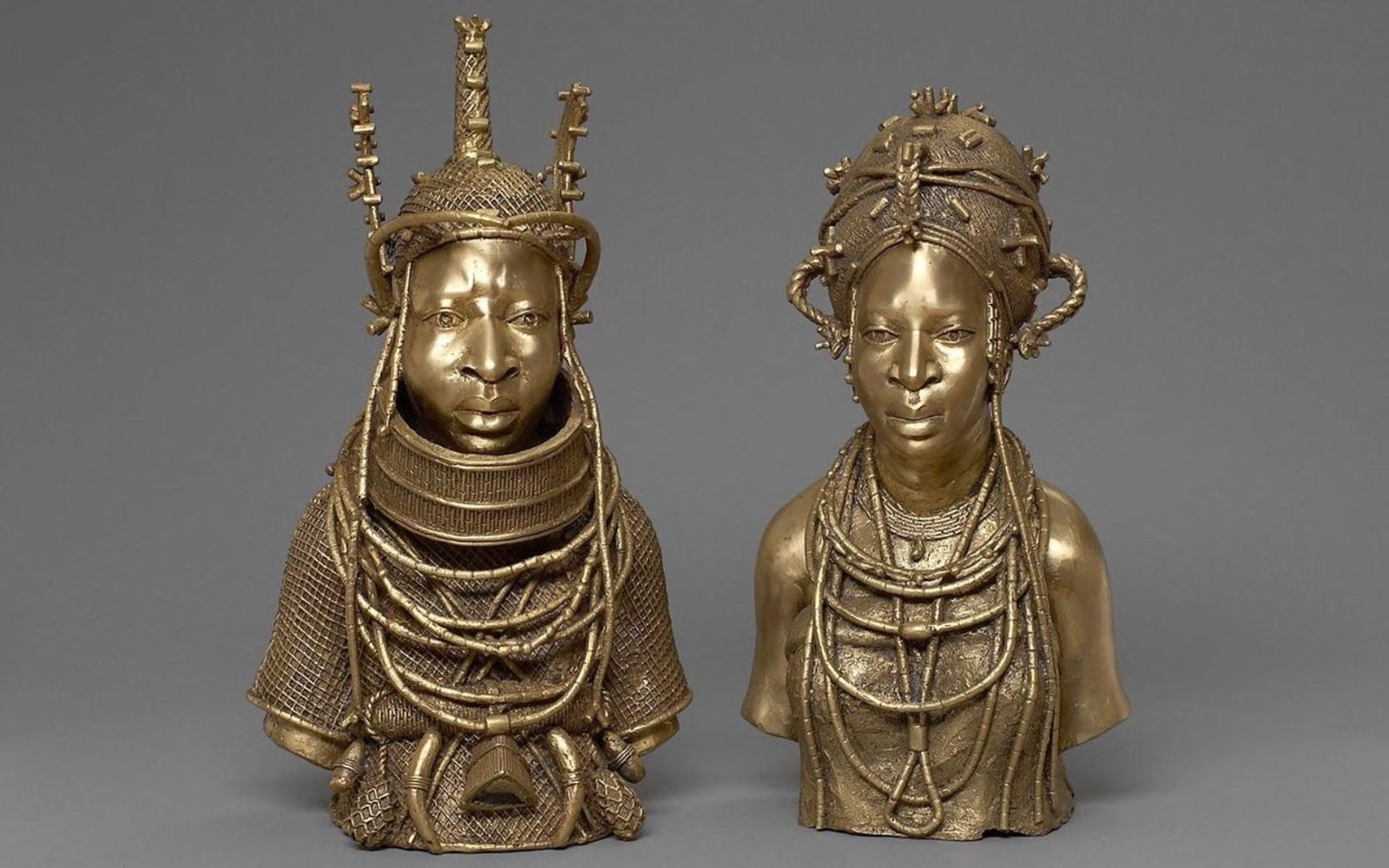
For more than a century, the Benin Bronzes – intricate plaques, royal heads, ceremonial figures and finely cast metalwork once used to decorate the royal palace of the Kingdom of Benin – have sat behind glass in museums across Europe and North America.
Mostly dating back to the 15th and 16th centuries, they were held by Benin kings until most were taken during the British Benin Expedition of 1897, when colonial forces looted thousands of artifacts and dispersed them across Western museums and collections.
In February, Cambridge University’s Museum of Archaeology and Anthropology became one of the first British institutions to transfer legal ownership of more than 100 of these works to Nigeria’s National Commission for Museums and Monuments.
The move marked a rare concession in a much larger dispute. Thousands of artifacts taken during the colonial era remain in museums and private collections abroad.
An estimated 90–95% of Africa’s cultural heritage is still held outside the continent, often beyond the reach of the communities from which the objects originated.
Efforts to return them have long been slowed by legal hurdles, contested ownership claims and resistance from institutions reluctant to let them go.
“The initial positive desire to deal with this issue has slowly hardened into a refusal to consider returning African cultural objects,” Sylvester Okwunodu Ogbechie, an art history professor at the University of California, Santa Barbara, told Anadolu.
He said institutional responses range from Germany’s active efforts to return looted artworks to cases of refusal in Britain, with offers to “loan” Benin pieces for exhibition in Nigeria, which he said “validates British ownership of the works in question.”
Structural control
Analysts say the debate over restitution has long been shaped by Western institutions themselves.
“Western institutions have controlled the terms of the restitution debate for decades – who gets to speak, what counts as evidence and what pace of return is considered ‘reasonable,’” Koehun Aziz, a communications associate, and Karen Ijumba, a senior researcher at Open Restitution Africa (ORA), told Anadolu.
They described institutional resistance as “structural rather than principled.”
The pattern, they said, can be seen in the global response to French President Emmanuel Macron’s 2017 pledge to return African artifacts – despite similar demands being voiced by African scholars and governments for decades.
“It reflects a broader pattern in which African agency is rendered invisible so Western gestures appear generous rather than overdue.”
Deadria Farmer-Paellmann, founder and executive director of the Restitution Study Group, is spearheading a global effort to return the Benin Bronzes to shared care, bringing together Afro-descendants, Nigerian institutions, the Benin Kingdom’s royals and museums.
“What we’ve been faced with is erasure, complete exclusion from the discussion,” she told Anadolu. “The biggest issue is changing the historical narrative that excluded us.”
She said activists are often cast as adversarial for pushing institutions to offer complete narratives around how the artifacts ended up in the West, which often relate to the slave trade and colonialism.
“It’s very important that people know what they’re looking at, especially Afro-descendants,” she said.
She said “doors are opening” with some institutions adjusting to demands, while others remain “a little bit more stubborn.”
Argument of superior stewardship
One of the key arguments used to resist restitution is that Western museums are better equipped to preserve and protect the artifacts.
Aziz and Ijumba said institutions often cite expertise, security and conservation standards to justify keeping African objects abroad.
The argument, however, is challenged by high-profile thefts at the Louvre and the British Museum, which have exposed gaps in even the world’s most prestigious institutions.
“This is the usual strategy of holding Africans to impossible standards. Art theft is a global problem,” Ogbechie said, noting that Benin kings held the bronzes for five centuries before the British took them.
Even as African countries build Western-style museums to Western standards, repatriation remains stalled, he said, pointing to examples like the British Museum’s lack of willingness to return its extensive Egypt collection to the Grand Egyptian Museum in Giza.
Shared heritage debate
Western institutions often invoke the concept of shared human heritage to justify keeping African artifacts in Western institutions.
But critics say that framing overlooks the historical context of their removal and the unequal access that persists today.
“To portray themselves as guardians of global heritage is disingenuous because no Western country will issue a visa to an African who simply wants to visit, for example, the British Museum,” said Ogbechie.
Aziz and Ijumba added that the argument reinforces unequal power dynamics.
“We did not consent to our heritage being removed and reinterpreted within Western institutions, yet we are often asked to be grateful that it is now ‘shared,’” they said.
They called the framing “a kind of historical laundering” that obscures the objects’ colonial acquisition.
“One cannot invoke the universal value of an object while ignoring how it was taken,” they said.
Legal battle over ownership
Legal arguments have also complicated restitution efforts.
Aziz and Ijumba said African countries often have to navigate complex legal systems shaped by Western institutions.
“Much of what Western institutions present as fact is itself perspective, institutionalized and legitimized over time,” they said.
Ogbechie said reparatory frameworks are negotiated in Western contexts, pitting Western lawyers against African officials, some of whom are unclear on the consequences of the agreements they sign.
The scholar said he viewed restitution not simply as returning stolen African artifacts, but as a legal struggle to secure full intellectual property rights for their African makers.
“Were this legal precedent achieved, it would have meant that countries with looted African art would need to negotiate whether they keep the objects and pay rent on them, or return them to their countries of origin,” he said.
Experts also point to a lack of an Africa-led framework to drive restitution efforts. Aziz and Ijumba noted that cooperation across African countries and the diaspora remains limited, with no unified platform linking national and international efforts.
At the same time, international organizations are positioning themselves as facilitators.
“Restitution is not a unilateral act, but increasingly the reflection of a new relational ethic,” a UNESCO spokesperson told Anadolu.
The official said cooperation with regional bodies such as the African Union offers “promising avenues” for more coordinated strategies.
Amid challenges such as varied legal frameworks and complex provenance research, the spokesperson said UNESCO will act as a facilitator, guiding nations toward cooperative solutions.
Price of stolen heritage
Some experts argue that returning artifacts alone is not enough.
Ogbechie said restitution should also include financial redress for communities affected by colonial plunder.
He pointed to precedents like the compensation Britain paid to slave owners after abolishing slavery, which fueled its industrial rise, and the reparations Germany paid to victims of Nazi persecution.
Africa, he said, has yet to see redress for five centuries of atrocities, with the US refusing reparations for slavery and the UK and other colonial powers denying reparations for colonization.
“And now, these same governments refuse to pay reparations to Africans as part of restitution of cultural heritage,” said Ogbechie.
Farmer-Paellmann, however, said her group is focused less on financial compensation and more on shared control.
“We really want to be a part of the decision-making process on how these relics are described in the institutions. We want to make sure that the slave trade origin is included.”
She added that the focus should also be on giving students the resources, access and support to explore and understand the artifacts firsthand.