BAMAKO, Mali
- Malian army describes attackers as ‘terrorist groups,’ videos and images circulating on social media linked them to JNIM militant group
- Azawad Liberation Front, a Tuareg-led rebel alliance, claims to have seized several positions, as scale and simultaneity of assaults, which span hundreds of kilometers, pose significant challenge to Malian authorities
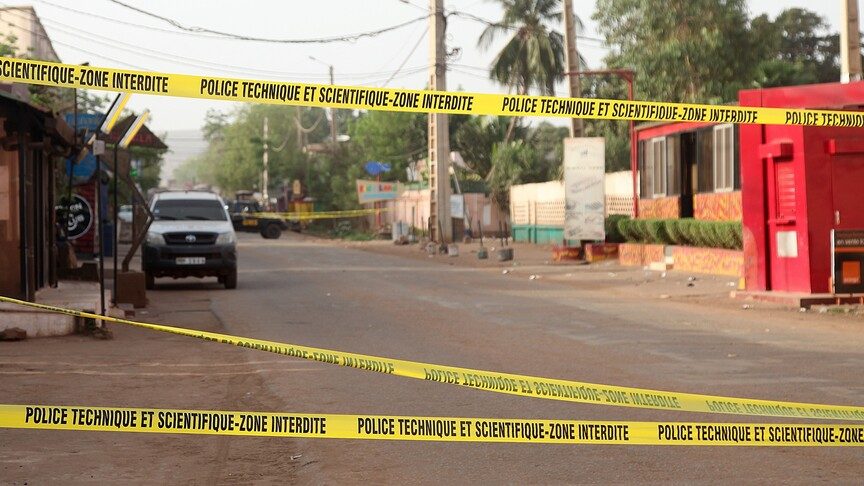
Mali experienced a rare wave of simultaneous terrorist attacks on Saturday, with sources and eyewitnesses saying military bases were targeted, one helicopter was shot down, and 10 militants were killed in intense clashes.
However, the government later announced that the situation had been brought under control but did not provide information on the number of people killed and injured or the extent of damage to military infrastructure.
Fighting erupted early in the morning in the capital of Bamako, the nearby town of Kati, Sevare in the center, and northern areas such as Gao and Kidal.
The Malian army described the attackers as “terrorist groups.” Videos shared by residents and images circulating on social media have been linked to militants from JNIM, an al-Qaeda-affiliated militant group.
In the north, the Azawad Liberation Front (FLA), a Tuareg-led rebel alliance, claimed to have seized several positions, including the governor’s residence in Kidal.
The scale and simultaneity of the assaults, spanning hundreds of kilometers, represent a significant challenge for Malian authorities.
How things unfolded
The attacks began early Saturday morning at multiple military sites. In and around Bamako, witnesses reported heavy gunfire and explosions near the Senou military camp, near the international airport, and in the Mamaribougou district on the city’s outskirts.
A police source told Anadolu, on the condition of anonymity because he was not authorized to speak to the media, that the airport remained under government control, with patrols stationed in surrounding areas, despite sporadic fighting in some sectors.
The most symbolic strike targeted Kati, home to the country’s main military base and the residences of Defense Minister Sadio Camara.
Authorities confirmed that Camara was unharmed, but witnesses reported that his home had been heavily damaged or partially destroyed. Abdoulaye Diarra, a Kati resident, told Anadolu that about 10 suspected attackers’ bodies had been recovered.
In northern Mali, a Malian military helicopter was reportedly shot down near Wabaria, close to the main city of Gao.
The Azawad Liberation Front (FLA) claimed on social media to have seized positions in Kidal and Gao. The FLA, a Tuareg-dominated coalition, continues to claim the territory it calls Azawad and carries out operations in the north, such as in Kidal and Gao.
The Tuareg are a large Berber pastoralist people who live in the Sahara Desert of North and West Africa, including Mali.
Separatists often distinguish their secular, nationalist struggle from that of militant groups like JNIM, although opportunistic alliances have occurred in the past. For them, Azawad is not merely a territorial issue but an existential one: cultural recognition, dignity, and the right to self-determination.
Images that could not be independently verified showed the governor’s residence in Kidal under their control. Security sources and resident videos have linked JNIM fighters to operations in the Bamako and Kati areas. The US Embassy urged its citizens to take shelter.
The exact casualty toll remains unclear, and the army had not issued a detailed operational update by late Saturday. Fighting had subsided in some districts of the capital by evening but continued elsewhere.
Who are the actors involved?
Two distinct but parallel threats appear to be at work. JNIM, the main militant group in central and northern Mali, has carried out attacks on military positions for years. Although it has not formally claimed Saturday’s assaults, several security sources directly link it to operations in the Bamako-Kati region.
The FLA, a coalition of Tuareg factions formed in late 2024, claims territorial gains in its traditional northern strongholds, pursuing a more secessionist or autonomist agenda.
While the two groups do not have a formal alliance—militants seek to impose an Islamic state, whereas the FLA is largely secular—their simultaneous actions indicate a tactical convergence aimed at exploiting Malian forces’ weaknesses.
Why now?
The timing is not coincidental. Mali has faced growing pressure since 2025. JNIM has imposed a fuel and supply blockade on Bamako since Sept. 2025, causing shortages and price increases that affect the population.
At the same time, the “national conference” of July 2025 extended transitional president Gen. Assimi Goita’s mandate until at least 2030, while postponing elections and dissolving political parties.
These decisions consolidated the military regime’s power while increasing its isolation. After French troops and the UN peacekeeping mission (MINUSMA) left between 2023 and 2024, Bamako relied on elements of the Russian Africa Corps. The results have been mixed: some territorial gains in the north, but also significant losses and accusations of abuse, which have occasionally alienated local populations.
Saturday’s attacks appear intended to demonstrate that neither Russian support nor the “sovereignty” narrative has restored stability while stretching Malian forces across vast distances. The FLA’s resurgence follows the collapse of the 2015 Algiers peace agreement, which the military regime has largely set aside in favor of a military approach.
Political context
Goita has led Mali since the coups of 2020 and 2021. He presents his government as a response to corruption and foreign interference. He has drawn closer to Russia and other partners while forming the Alliance of Sahel States with Burkina Faso and Niger, thereby leaving the Economic Community of West African States (ECOWAS).
Although the sovereignty discourse appeals to some people, critics argue that an exclusively security-focused approach has overlooked inclusive dialogue, economic development, and the resolution of long-standing grievances such as northern marginalization, ethnic tensions, and poor governance. Attacks on sensitive sites near the capital, which were previously uncommon, now demonstrate the limits of this strategy.
Civilian life in Bamako and Kati has been disrupted by residents being confined indoors, the blockade affecting markets, and fears of additional violence or reprisals. Autonomist aspirations in the north have persisted for over a decade.
What comes next?
By late Saturday, the military had not yet issued a detailed response or provided a complete casualty count. A counter-offensive is expected, possibly with Russian support, but the risk of escalation, including reprisals or a tightening of the blockade, exists.
Russia provides significant military and security support to Mali’s military junta through the Africa Corps, which is the successor to the Wagner Group and assists in combating militants while protecting the government from internal threats.
The Malian crisis has spread beyond remote desert areas and is now affecting the outskirts of the capital. The authorities’ ability to respond not only militarily but also by addressing structural causes will determine whether these events are a one-time blip or the onset of a more dangerous cycle.