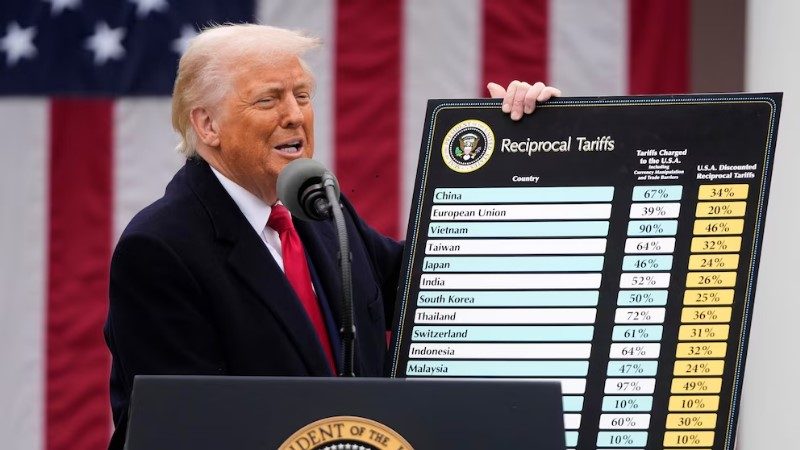
United States President Donald Trump, on Friday, announced plans to increase tariffs on cars and trucks from the European Union to 25 per cent.
Mr Trump, in a post on Truth Social, said the decision, which will take effect next week, follows the EU’s alleged failure to comply with the trade deal.
“I am pleased to announce that, based on the fact that the European Union is not complying with our fully agreed to trade deal, next week I will be increasing tariffs charged to the European Union for cars and trucks,” Mr Trump said in a post on Truth Social.
“The Tariff will be increased to 25 per cent.”
He added that vehicles produced in the U.S. would be excluded from the tariff.
“Many automobile and truck plants are currently under construction, with over 100 billion dollars being invested, a record in the history of car and truck manufacturing.
“These plants, staffed with American workers, will be opening soon.—There has never been anything like what is happening in America today!” Mr Trump stated.
Responding, Bernd Lange, the chair of the EU Parliament’s international trade committee, said Mr Trump’s decision was “unacceptable.”
“Trump’s behaviour is unacceptable,” said Mr Lange. “The European Parliament was about to ratify the legislation on the trade agreement with the United States. It is they who have repeatedly broken the agreements, and this is not how you treat allies.”
Per the deal negotiated last July, the tariffs on goods from the EU to the U.S. were set at 15 per cent.
The agreement, sealed at Mr Trump’s golf course in Scotland, offered relief to the EU after he threatened to impose a 30 per cent tariff as part of his “Liberation Day” measures in April.
The EU had also agreed to invest in the U.S. and to adopt measures expected to boost U.S. exports.
In January, the European Parliament put the deal on hold amid tensions over Mr Trump’s threat to annex Greenland, a self-governing territory in Denmark.
However, it later added a clause that allows the agreement to be suspended if Mr Trump’s administration is found to have undermined the deal’s objectives; threatened the territorial integrity of member states, foreign, and defence policies; engaged in economic coercion; or discriminated against EU economic operators.
The European Parliament approved the deal in March.