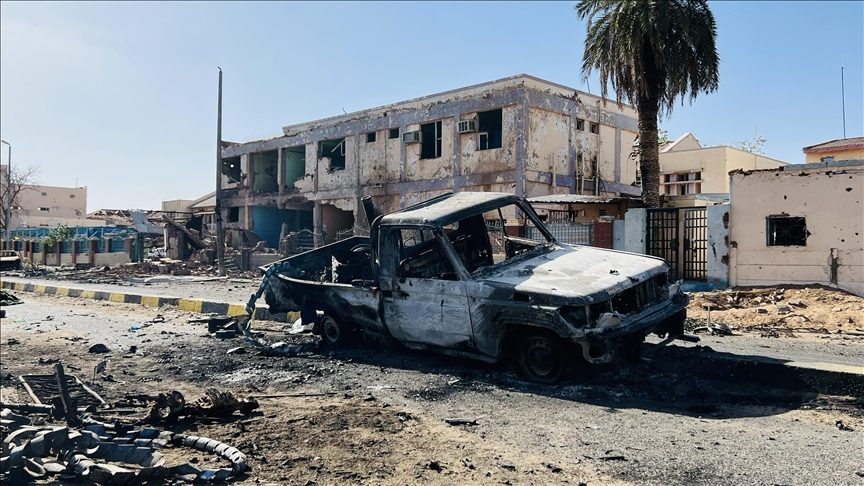
Eighty per cent of civilian deaths in Sudan between January and April resulted from drone attacks, according to UN High Commissioner for Human Rights Volker Türk.
Mr Türk said on Monday that at least 880 civilians were killed in drone strikes between January and April 2026 as the fighting between the Sudanese Armed Forces (SAF) and the paramilitary Rapid Support Forces (RSF) rages.
“Drones caused more than 80 per cent of civilian deaths in Sudan’s war during the first four months of 2026, killing at least 880 people,” the UN official said in a statement.
He condemned the war, which recently entered its third year, and warned that it could be pushed into a “deadlier phase” as drone warfare escalates.
Health facilities were struck at least 12 times between January and April, with some shutting down, and civilians bore the brunt as they travel long distances for medical care, according to the high commissioner.
“Armed drones have now become by far and away the leading cause of civilian deaths,” he said. “This increasing reliance on drones allows hostilities to continue unabated in the approaching rainy season, which in the past has brought about a lull in ground operations.”
Warning that fighting could spread further in the coming weeks as “the parties seek to gain or consolidate control of territory amid shifting conflict dynamics,” he said that more people could be displaced.
“This must not be allowed to happen,” he said. “The international community is on notice that, unless action is taken without delay, this conflict is on the cusp of entering yet another new, even deadlier phase.”
Most of the drone-related deaths were recorded in the Kordofan region, with the most recent occurring on May 8, Mr Türk said.
The high commissioner stated that strikes on Al Quz in South Kordofan and near El Obeid in North Kordofan killed at least 26 civilians and injured several others, with the use of drones spreading to Blue Nile, White Nile, and Khartoum.
He noted that civilians are at risk of retaliatory attacks amid the escalating hostilities in Kordofan.
The high commissioner warned that humanitarian operations could be further disrupted, as large parts of Sudan face increased risks of acute hunger and famine.
He called for measures to stop the transfer of arms and urged parties to ensure the protection of civilians.
The fighting in Sudan between the SAF, led by Gen. Abdel Fattah al-Burhan, and the paramilitary RSF led by Gen. Mohamed Hamdan Dagalo over control of power began on April 15, 2023.
Tension between Messrs al-Burhan and Dagalo followed the ousting of President Omar al-Bashir in 2019. Mr al-Bashir came to power in a coup in 1989.
According to the World Health Organisation, 33.7 million people require assistance in 2026. It is estimated that 11.5 million people have been displaced due to the conflict.
“Through WHO’s Surveillance System for Attacks on Health Care (SSA), 201 attacks with 1,858 deaths and 490 injuries have been formally validated between 15 April 2023 and 31 December 2025, and more than 1,600 deaths have been recorded in 2025,” it said.