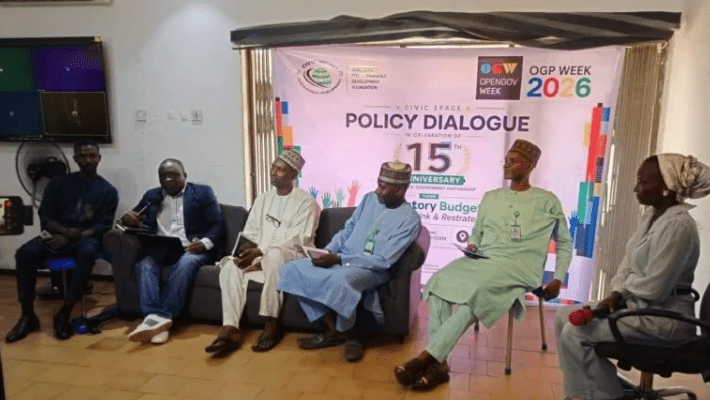
Stakeholders have called for stronger citizen participation, transparency, and accountability in budgeting in Kaduna.
The stakeholders made the call on Wednesday in Kaduna during the Civic Space Policy Dialogue 2.0 held as part of activities commemorating the 2026 Open Government Partnership Week.
The dialogue, organised by Civil Impact for Sustainable Development Foundation, brought together government officials, civil society groups, and development partners to assess progress and identify gaps in participatory budgeting.
Citizens co-chair of Participatory Budgeting under OGP Kaduna, Seth Luke, said the meeting aimed to review achievements since Kaduna joined OGP and develop recommendations for reforms.
Mr Luke said stakeholders also examined challenges affecting participatory budgeting and explored ways to strengthen digital platforms and legal frameworks for sustainability.
The OGP Point of Contact in Kaduna, Tara Jeremiah, said Kaduna’s consistent observance of OGP Week reflected growing collaboration between government and civil society.
Mr Jeremiah noted that Kaduna had progressed from its first State Action Plan to a third, describing the achievement as evidence of sustained reforms in open governance.
He urged participants to engage constructively, stressing that OGP thrives on dialogue and cooperation rather than confrontation between government and citizens.
Mr Jeremiah cited recent late-night engagements between officials and stakeholders on service delivery issues as signs of increasing government commitment to accountability.
Executive director of Paradigms Leadership Support Initiative, Olusegun Elemo, praised Kaduna’s strides in public finance management and citizen-participatory audits since 2016.
Mr Elemo said co-produced policies usually deliver better results than top-down approaches, urging stakeholders to improve value for money in public spending.
BudgIT country director, Vahyala Kwaga, said participatory budgeting becomes meaningful when citizens actively shape priorities, monitor projects, and track implementation outcomes.
Mr Kwaga warned that consultations alone do not guarantee accountability, insisting that citizen contributions must influence final decisions and policy execution.
He called for better inclusion, timely public access to budget data, stronger feedback mechanisms, and deeper institutional collaboration to sustain reforms.
OGP national advisor, Uchenna Arisukwu, urged stronger political will and increased funding for OGP programmes at national and state levels.
Mr Arisukwu commended Kaduna for introducing the Citizen Delivery Tracker, urging residents to actively use the platform to monitor government performance and demand accountability.
Sharing Kaduna’s experience, Adejor Abel of Citizens Center for Inclusive Development and Sustain Initiative said budget documents were once inaccessible and civic engagement heavily restricted.
Mr Abel said budgets are now publicly available online, while town hall meetings and legislative public hearings have expanded citizen involvement in governance. He credited the Community Development Charter framework for linking over 255 wards with civic champions across Kaduna’s local governments and zones since 2017.
According to Mr Abel, more than half of local government capital budgets now reflect citizens’ priorities, although some nominated projects still lack cash backing and implementation.
(NAN)