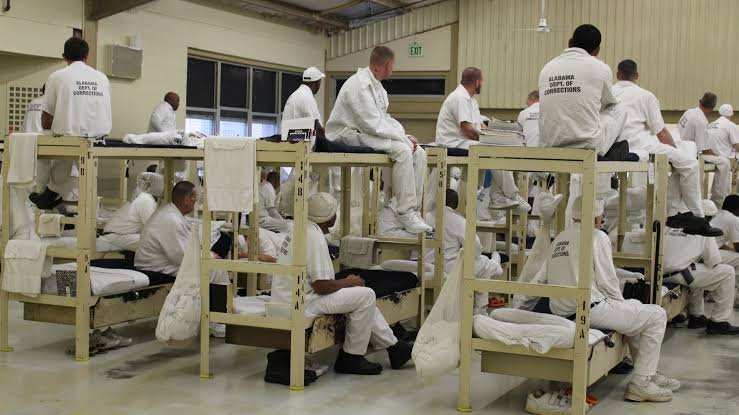
Nigeria, Ghana, and Somalia, respectively, rank first, second, and third among the 46 African nations with citizens jailed in U.S. federal prisons, Peoples Gazette can report. A document, exclusively obtained by The Gazette, revealed the number of African nationals in U.S. federal prisons.
The document showed that 46 out of Africa’s 54 nations collectively have at least 914 inmates languishing in U.S. federal prisons for different crimes, ranging from drug trafficking, burglary, theft, romance fraud, and wire fraud, among others, as of May 22.
Nigerians top list of African inmates
Nigeria, the giant of Africa located in West Africa on the Gulf of Guinea, leads the entire continent with 283 of its citizens jailed in U.S. federal prisons, the document showed. Nigeria’s 283 inmates constitute 30.8 per cent of the 914 Africans serving various jail terms in U.S. federal prisons, far away from their continent.
Some known Nigerians still serving time in U.S. gaols include notorious internet fraudster Ramon ‘Hushpuppi’ Abbas, Invictus Obi, Oba Joseph Oloyede, the Apetu of Ipetumodu in Osun State, Paulinus Okoronkwo, and Professor Nkechy Ezeh.
Ghana, another country in West Africa, trails Nigeria with the second-highest number of citizens jailed in U.S. federal prisons. According to the document, 71 Ghanaians jailed for various crimes constitute 7.7 per cent of Africans in America’s federal prisons.
With 68 citizens serving jail terms for different crimes, Somalia, an East African country, ranked third among the top 10 African countries with inmates in U.S. federal prisons.
Somalis constitute 7.3 per cent of African inmates in U.S. federal prisons, while Sudan, a North African country, ranks fourth with 55 inmates, who constitute 5.9 per cent of African inmates in U.S. federal prisons.
Another East African country, Kenya, has 49 inmates, the fifth-largest number of prisoners of African descent in U.S. federal prisons. Kenyans constitute 5.3 per cent of Africans jailed in the U.S.
Egypt and Liberia, respectively, have 43 and 42 citizens jailed in U.S. federal prisons, constituting 4.6 and 4.5 per cent of African inmates in America’s federal prisons.
The trio of Ethiopia, Cameroon, and South Africa, respectively have 40, 28, and 24 of their citizens serving various jail sentences in U.S. federal prisons. Inmates of Ethiopian, Cameroonian, and South African origin, respectively, constitute 4.3, 3.0, and 2.6 per cent of African inmates in U.S. federal prisons.
The 914 inmates from Africa also include 20 Moroccans, 19 Guineans, 16 Ivorians, 15 Nigeriens, 14 Sierra Leoneans, 13 Cape Verdeans, 10 Congolese, and 10 Angolans. While Senegal has nine inmates in U.S. federal prisons, Tanzania and Libya each have seven inmates. Gambia and Eritrea, respectively, have six citizens in U.S. federal prisons, while Zimbabwe, Zambia, Uganda, Mali, and Mauritania, respectively, have five of their citizens in U.S. federal prisons.
Tunisia, Togo, Burundi, and Algeria, respectively, have four citizens serving jail terms in U.S. federal prisons. Rwanda, the Central African Republic, and Benin each have three inmates in U.S. federal prisons, while Guinea-Bissau, Gabon, and Burkina Faso each have two inmates. South Sudan, Namibia, Mozambique, Malawi, Equatorial Guinea, Djibouti, and Botswana, respectively, have one inmate each, the lowest number in U.S. federal prisons.
Bayo Onanuga and Daniel Bwala, spokespersons for the Nigerian government, did not return The Gazette’s request for comment. However, the spokesperson for Nigeria’s foreign ministry, Kemiebi Ebienfa, noted that Nigeria has the “largest population in Africa”.
“So if we have people who have committed offences in other countries, our numbers will be higher than in countries with tiny populations,” Mr Ebienfa said. “There is nothing special about it.”
Asked if increasing cases of Nigerians jailed for crimes in the U.S. could negatively impact the country’s image and sway foreign investors’ decisions, Mr Ebienfa said, “A fraction of our people committing offences abroad does not mean that is how the world will see us. No. We have Nigerians who are very successful in the U.S., both in the private and public sectors.”
Felix Kwakye Ofosu, Ghana’s communications minister, also did not return a request for comment.
Speaking on the growing number of Nigerians incarcerated in U.S. prisons, Christopher Isike, a professor of African Politics and International Relations at the University of Pretoria, South Africa, said, “Increasing cases of Nigerians jailed abroad for criminality have significant implications for Nigeria’s international image and also for broader perception of Africans and Africa in global political and economic discourses.
“It tends to reinforce long-standing negative stereotypes that associate ls Nigeria with criminality. This could subject innocent Nigerians to profiling, stringent visa laws and dehumanising immigration policies in the international sphere.”
‘Not evidence of continental criminality’
Simon Mulongo, a Ugandan financial adviser and international relations expert, said, “Nigeria, Ghana, and Somalia ranking first, second, and third may reflect criminal involvement, but it also reflects diaspora size, English-language access, migration corridors, refugee histories, and stronger exposure to U.S. law enforcement systems. The figure of over 900 African citizens in United States federal prisons should be interpreted with proportional caution. In absolute terms, it is politically significant. In demographic terms, it is extremely small.
“The U.S. has roughly 2.5 million sub-Saharan African immigrants, meaning that 900 federal inmates would represent about 0.036 per cent of that population, or roughly 36 inmates per 100,000 sub-Saharan African immigrants. That is not evidence of continental criminality. It is evidence of a small but reputationally powerful criminal minority operating within transnational digital and financial networks.”
He added, “I would therefore treat the data as a reputational risk indicator, not as a moral measure of Africa. Politically, however, it is not negligible because crime statistics are often converted into stereotypes, visa restrictions, banking suspicion, and migration control. More African convictions for wire fraud, romance scams, and financial crimes would likely lead to tougher visa screening, more digital background checks, stricter consular interviews, and higher refusal rates. The result would be collective suspicion, even against highly qualified applicants.”
According to Mr Mulongo, from a political economy perspective, the issue reveals the dark side of uneven globalisation. African youth are increasingly digitally skilled, globally connected, and exposed to consumer capitalism, but many African economies cannot absorb them into formal employment.
The Ugandan international relations expert said, “Where unemployment, corruption, weak policing, and social inequality intersect, cyber fraud becomes an illicit pathway to mobility and status. This does not excuse the crime. It explains why fraud networks emerge in environments where legitimate opportunity is structurally constrained.”
“The prison figures do not indict Africa. They expose a governance and development challenge. The real issue is not that Africans are inherently prone to crime. The real issue is that a small number of cyber-enabled offenders can impose large reputational, diplomatic, and economic costs on the continent. A few hundred or few thousand fraud cases can damage the credibility of millions of lawful African migrants, students, entrepreneurs, academics, and professionals.”