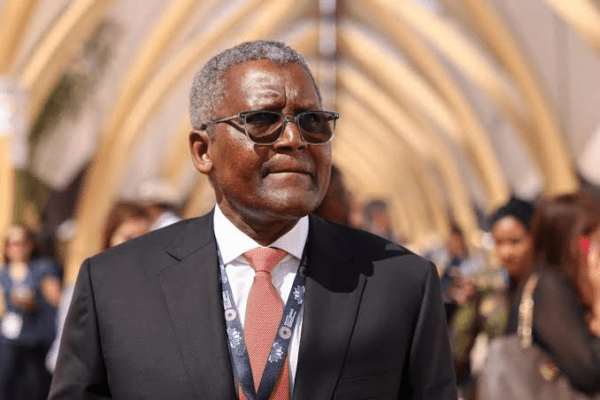
“I don’t really look at those things,” he said when recently asked about his net worth.
He started business at eight years old, selling candies to his classmates. Over the decades, he has grown into one of the world’s richest men.
His multinational conglomerate was estimated to be worth $35.2 billion (₦47.45 trillion based on ₦1,348 to $1), according to Bloomberg’s ranking as of August 20. This makes him the 66th richest person globally.
With his enormous wealth, the industrialist recently told The School of Hard Knocks that he “passed the stage of doing business to make money; it is a legacy”.
How did he amass $35.2 billion?
Born in Kano in 1957, Aliko Dangote, the founder of Dangote Group, said in an interview with PBS that he “built everything from scratch”, with several of his companies listed on the Nigerian Stock Exchange.
Mr Dangote returned to Nigeria and started a cement trading business using a loan from his uncle. Mr Dangote said he delved into cement production after he learnt that Africa imported most of its cement.
In 1981, Mr Dangote incorporated other businesses, including sugar, flour, fish, rice, fertilisers, and others, establishing the Dangote Group. Dangote later began building salt and sugar refineries, flour mills and a pasta factory.
It expanded into several other sectors, including oil refining, petrochemicals, seasonings, packaging, agriculture, energy, infrastructure and automotive manufacturing.
His business interests include Dangote Cement Plc, Dangote Petroleum Refinery and Petrochemicals, Dangote Fertiliser Limited, Dangote Sugar Refinery Plc, NASCON Allied Industries Plc, Dangote Packaging Limited, Greenview Development Nigeria Limited, and Dantrans Limited.
Mr Dangote’s biggest asset remains the $20 billion Dangote Oil Refinery, with a capacity of 650,000 barrels, which began operations in September 2024 and remains Africa’s largest refinery.
Recently, the refinery said it secured a $1 billion underwriting programme ahead of its planned initial public offering. According to the refinery, the programme comprises a completed $600 million tranche, coordinated by co-financial advisers Marob Strategies and Consulting DIFC Ltd and Lilium Capital Group.
It said it would implement an additional $400 million underwriting commitment to support the IPO when launched, subject to regulatory, corporate, and market conditions.
Recently, the industrialist said he was targeting Mombasa, Kenya, as the site for his 650,000-barrel-per-day refinery in East Africa, a project estimated to cost between $15 billion and $17 billion.
“I’m leaning more towards Mombasa because Mombasa has a much larger, deeper port,” Mr Dangote said in an interview with the Financial Times published in May.
Mr Dangote also said plans were underway to scale up the capacity of his Lagos refinery to 1.4 million barrels per day, making it the world’s largest refining facility.
Stock market performance
According to Dangote Cement’s 2025 annual report, Mr Dangote ultimately owns 86.65 per cent of Dangote Cement through Dangote Industries. The company, which has a total production capacity of 55 million tonnes, recorded ₦4.31 trillion in group revenue in 2025.
Currently, Dangote Cement, with a market value of ₦17.32 trillion, trades at ₦1,034.00 on the Nigerian Exchange and has recorded more than 98.85 per cent one-year return growth.
Dangote Group has three companies listed on the Nigerian Exchange: Dangote Cement, Dangote Sugar Refinery and NASCON Allied Industries.
Checks on the Nigerian Exchange indicate that Dangote Sugar Refinery Plc trades at ₦69.85, with a market valuation of ₦829.63 billion. NASCON Allied Industries Plc, with a market value of ₦526.97 billion, trades at ₦195.00.
Mr Dangote’s wealth grew by $5 billion amid the conflict between the U.S. and Iran, which drove global oil prices higher as the Strait of Hormuz—the narrow waterway between Iran and Oman—became a battleground and disrupted the global oil market.
Devakumar Edwin, a vice-president of Dangote Industries, disclosed that Dangote Refinery was Europe’s largest supplier of jet fuel and diesel in July, the New York Times reported.
“When the war broke out, traders and governments from all around the world—especially in Africa—started calling us for supplies,” said Mr Edwin. “The crude oil prices have gone up, but the product prices have increased a lot more.”
Daniel Evans, a vice-president of S&P Global Energy, also noted that the refinery was “the world’s single largest exporter of jet fuel” in April and May.