
Mokola community in the Ibadan North Local Government Area of Oyo State features several spectacles, including child beggars occupying the dusty floor beneath the branded flyover bridge most of the busy hours each day.
The sight of the children in worn-out clothes, trailing commuters exiting cabs and passersby heading to their various destinations to request money is not new to the location.
At the area on Wednesday, July 11, at 12:15pm, a group of women, alongside three school-age children sat under the bridge in their usual manner, chatting merrily among themselves. There were everyday items, including polythene bags, water containers, a sack and a broom, around them.
Moments later, one of the women rose to distribute some newly received items to members of the group. She returned to her seat on a clothing spread on the dusty floor. Their inaudible conversation continued as micra drivers, private cars and heavy-duty vehicles honking sped past the busy Mokola roundabout.
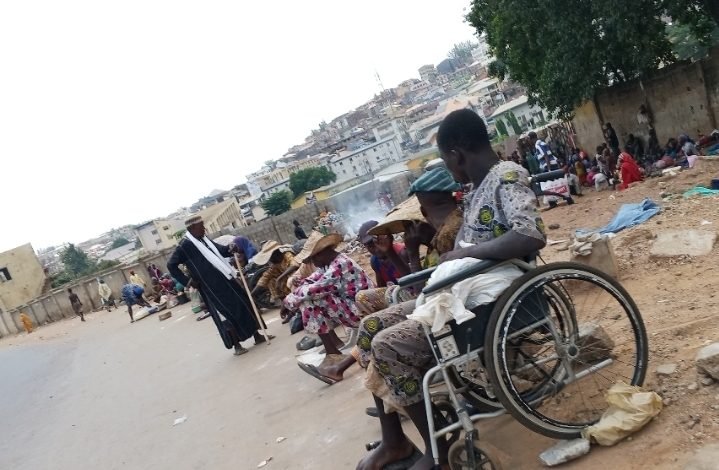
Barely some distances from the Mokola flyover, a line of beggars, including an adolescent in a wheelchair, sat under the scorching sun in front of St Gabriel’s Secondary Commercial School.
This second scene comprised people of different ages, marked across genders. They sat stretching into the road shoulder linking Letmauck Cantonment to the Ibadan Golf Club, along Onireke GRA.
Only a few of the beggars shielded themselves with hats or umbrellas. Items such as water containers and sacks were placed nearby, as each beggar waited in anticipation of passersby who might stop to offer charity.
At about 1:49pm on the same day, a similar group of beggars gathered approximately 9.8 kilometres away from Mokola. It was a much longer line than the two preceding ones. They formed a straight line over the Sabo Ojoo bridge, along Odogbo Barracks.
A few minutes later, a scene emerged as elderly men, women and some underage beggars scrambled to collect some gifts brought by an alms giver in a white car. Suddenly, a noise broke out after a tout pushed through the crowd and fled with one of the donations. These are the daily routine and scenes surrounding the beggars and destitute in the visited locations.
The shoddy evacuations
The Oyo State Government on Wednesday, May 13, evacuated homeless and beggars roaming major areas in the Ibadan metropolis to the internally displaced persons and destitute home in the Akinyele Local Government Area “for proper profiling, care, and rehabilitation.”
A statement by the state Commissioner for Information, Dotun Oyelade, said the vulnerable persons were raided, noting that the individuals filled two high-capacity buses.
“During the exercise, scores of destitutes and beggars constituting environmental and public order impediments were apprehended. The individuals, who filled up two high-capacity buses, were transported to the Internally Displaced and Destitute Home in Akinyele Local Government Area for proper profiling, care, and rehabilitation,” Mr Oyelade stated.
Reacting, the chairperson of the Oyo State Rule of Law Enforcement Authority (OYRLEA), Aderonke Aderemi, stated that the presence and activities of destitute and beggars on major roads and walkways within Ibadan posed serious environmental challenges, obstruct free movement and compromise public safety and hygiene.
A review by the Peoples Gazette, however, showed that the evacuation drive of Wednesday, May 13, was not the first of such a dramatic move by the Governor Seyi Makinde-led administration.
In July 2021, 14 mentally ill persons and 86 destitute from some popular areas in Ibadan were picked up from Mokola, Jemibewon, Challenge, Sango, Orita-UI and Ojoo to the rescue centre in the Akinyele LGA.
Further checks by The Gazette showed that the government conducted a similar exercise in January 2020, January 2022, September 2022 and October 2019, yet the beggars still occupy streets, highways and junctions.
On Thursday, May 14, the muddy road leading to the rehabilitation centre was occupied predominantly by female beggars, who sat on stones or the bare red earth. The women sat almost as a signpost to the rehabilitation facility.
At the facility, two rusty gates stood open, with no visible security presence. Some children were seen playing on the ground, while a group of young women in the first half-built structure in the camp, littered with torn clothes and frayed sacks, continued chatting.
Noticeably, there were damaged belongings, including foam, clothes, weakened wooden materials and roofing sheets dumped carelessly in the central part of the camp. A mosque adjacent oozed unsanitary condition. It was cluttered with sacks, unwashed plates and dried okro swarmed by flies.
A 50-year-old Abubakar from Zamfara State, who has a difficulty walking, told The Gazette that state government officials truly a group of street beggars and destitute to the facility on Wednesday, May 13.
He, however, noted that the evacuees left the facility one by one as soon as the government officials departed.
“Yes, they brought people here and the government wrote down their names and details. The government officials brought in some vehicles. Even this morning, they also brought some people, alongside some mentally ill people. But they have all left,” Mr Abubakar stated.
He stated that the relocated persons left the camp, largely because of the facility’s deplorable conditions, including lack of food, security and adequate housing.
“They left because there is no security and food. Before, we used to have security when this place was established. We used to have three police officers present here. Since they stopped feeding us after the seventh month, the security agents left because they also eat from here. The people evacuated have houses where they were brought from. We don’t have a nice place here to stay,” he said.
Similarly, 30-year-old Lauratu and long-time resident in the camp told this newspaper that none of the relocated persons agreed to stay due to the condition of the facility.
“Yes most of them said they can’t stay. We stay here because we are more like patients. We hawk to survive. Our children help us or other people’s children and we pay them afterwards,” Ms Lauratu stated.
She noted that the government should not have also brought mentally ill persons to the facility inhabited by beggars.
The Gazette on Thursday, May 21, while driving around the Ibadan metropolis, observed that street beggars had returned to locations such as Beere and Mapo, among others, which the Oyo State Government said it had cleared.
Squalid rehabilitation centre
For many residents, life in the camp has largely been defined by daily struggle for food, clothing, healthcare, survival and access to education.
Sharing her struggles in the rehabilitation centre, Amina Lawan from Kano State told The Gazette that she moved into the facility a few weeks after it was established.
She stated that her relocation followed the death of her husband and a belief that Ibadan was a hotspot for charity.
“I lost my husband while I was formerly based in Ijebu, Ogun State. I came to Ibadan because I heard that there were more charity centres here. I joined the camp a few weeks after it was established,” Ms Lawan said.
According to her, life in the camp has been characterised by difficulties, including the absence of facilities for women.
She noted that the situation led some of the female inhabitants to hawk seasonal foods or engage in begging.
Ms Lawan stated, “Some of us sell seasonal foods. Those who are left rely solely on begging. Some of the children go out to beg. Some parents beg, while others work.”
“On menstrual care, women take responsibility for themselves. There is no special room for personal care during menstrual periods. Everybody is concerned about themselves. We buy sanitary pads ourselves,” she stated.
She also cited the case of a male orphan currently residing in the facility, being collectively cared for until he attains an age where he is expected to join other children to fend for himself.
“There is an orphan child among us. We all look after him. Once he reaches a certain age, he will go out to look for work and find something to eat,” she said.
Also, Mr Abubakar, who earlier talked about the disappearance of the evacuees, said he became physically impaired after an accident.
According to him, the accident occurred during one of his business trips between the North and the South-West as a tailor and cloth trader.
“I am a tailor. I used to come to Ibadan and return. I used to come here to buy clothes and take them to the North. I was doing my work before I had an accident that affected my two legs. Now with my condition I beg and currently head the unit of people with my same condition as me here,” he said.
Mr Abubakar said the displaced persons within the camp use a nearby bushes for defecation. He added that they usually take their belongings to the mosque when it is about to rain amid the struggle for economic survival.
He stated, “As it rained earlier today, some had to stay inside the mosque. All we have been doing is to be patient. We have a well, and it is from it that we drink, wash and bathe. The borehole is not in use because it is not functioning. It’s over a year since the borehole project was stalled.
“Our children attend school here in the mosque Some volunteers come about three times a week to teach them.
“It has been over two years and some months since we last had a functioning toilet. We go to the bush. Even the children do the same. Despite the fact that there are snakes in the bush, we depend on God that nothing bad will happen.
“I take people out to go and learn work. The children go out to look for food and return when it is time to eat. Any of the women who decides not to beg, I take them out for work. They work for months, get settled afterwards and then return to the North.”
He stated that the rehabilitation facility was npw different compared to when it was newly established.
“We got food supplies, doctors checked on us and police officers were only here at the inception of the facility before they left years ago. This month makes it six years since we came here. People also come here to steal, like they did to the solar equipment installed by the government. However, people around do not disturb us.
“Our major problems are the lack of decent housing, water, food, and proper toilets. Since there is no food, people have to go out. That is why we depend on God. Even the well water is not enough for the camp. We use our money to take care of ourselves,” he stated.
Recalling his experience in the camp, Mr Abubakar claimed that a cholera outbreak in 2024 led to the death of some members of the camp.
“Eight persons died from a cholera outbreak two years ago. When we lodged complaints, the government provided purified water in dispensing jars, which lasted for one week. We did not receive drugs during that period,” Mr Abubakar said.
“But eight people died from the outbreak. During the period, we took care of ourselves and took others to the hospital. Some survived while some died. The government treated two persons who survived and have since returned to the North,” he said.
Oyo’s street beggars crisis
The World Population Review in a 2020 data estimated Nigeria’s homeless population at 24,400,000. It stated that there were 1,006 homeless Nigerians in every 10,000 people. The agency said its estimate included many “informal settlements” and other internally displaced persons.
A 2022 National Bureau of Statistics (NBS) survey, which sampled over 56,000 households across the 36 states of the federation and the Federal Capital Territory (FCT), stated that 63% of persons living in Nigeria (133 million people) were multi-dimensionally poor. It added that “65% of the poor (86 million people) live in the North, while 35% (nearly 47 million) live in the South.”
The report added that two-thirds (67.5%) of children (0–17) were multidimensionally poor according to the National MPI, adding that half (51%) of all poor people were children.
A 2024 report by UNICEF stated that Nigeria had the highest tally of out-of-school population, stating that about 10.2 million children were not in school at the primary level, while 8.1 others were absent at the junior secondary school level.
Stakeholders’ viewpoints
The chief executive officer of Shield of Innocence Initiative, Bidemi Nelson, said the prevalence of uneducated parents, questionable belief systems, peer pressure and a Nigerian social system celebrating accumulation of wealth without creating value were major drivers of street begging in Oyo State and Nigeria at large.
Ms Nelson said, “The increase in the population of uneducated parents and adults has contributed to the rise in poverty in society. Today, questionable belief systems are often rife among people, as many do not see any issue with adopting street begging as a profession.
“Also, the acceptance of street begging as a reputable source of livelihood, even among those who are not beggars, is part of the problem. Seeing beggars all over our streets, knocking on windows and almost entering our vehicles, has become too common and a new normal.”
Ms Nelson said that peer pressure, particularly among children plays a role in the rise of street begging, which in turn may lead to anti-social acts such as drug addiction.
“Peer pressure is one of the reasons why some people, including children, take to street begging. They may come from poor homes, understandably so, but when they go out to mingle with their friends, they see their friends eating and buying expensive things. A lot of these children use the proceeds to buy drugs, which they later become addicted to,” she said.
Ms Nelson stated that the prevalence of a Nigerian social culture celebrating wealth accumulation without creating value was an indirect and direct driver of street begging.
She noted that street begging exposes children to significant risks from predators both within and outside their immediate environment.
Ms Nelson stated, “These predators exist externally and sometimes even within familiar environments. Children often approach strangers and some of these individuals take advantage of their innocence and vulnerability by making manipulative demands such as, ‘Will you follow me if I give you 1,000 naira?’ and similar propositions.”
In his contribution, an urban planner and rights activist, Gideon Adeyeni, said that homelessness in Nigeria was a result of “the commercialisation and excessive pricing of housing.”
The activist stated that unemployment and destitution across Nigeria had been “worsened by economic restructuring and industrialisation that have occurred without any commitment to a just social transition.”
Mr Adeyeni stated, “Poverty should not be viewed merely as an individual failure or personal deficiency. It is frequently the outcome of social and economic systems that concentrate wealth in the hands of a few while denying large sections of society access to resources and opportunities.
“Poverty is produced on the scale we see under contemporary capitalism, people’s capacity and incentive to invest their labour and creativity productively are severely undermined. Under such conditions, begging becomes, for some, a means of survival rather than a matter of choice,” he added.
He stated that the presence of beggars on Nigerian streets should be understood as a reflection of structural social failures rather than as evidence of moral failure on the victims’ part.
Also, an Ibadan-based legal practitioner, Damilola Akinsanya, stated that the government have certain obligations to citizens irrespective of class or social condition, citing Sections 14 and 16 of the 1999 Constitution, as well as Article 5 (right to dignity), Article 6 (right to liberty and security), Article 16 (right to the best attainable state of physical and mental health) and Article 24 (right to a satisfactory environment) of the African Charter.
“Federal and state governments certainly have a non-exhaustive list of obligations to all its citizens irrespective of class or social conditions. As such, there is no distinction in the laws that apply to the welfare of residents of rehabilitation centres and all other citizens. For instance, section 14 of the 1999 CFRN states that the security and welfare of the people shall be the primary purpose of the government,” Mr Akinsanya said.
He noted that the government’s promises, however lofty, were “merely aspirational and cannot be enforced against the government except, for instance, where another law has imposed a duty on the government to provide such rights.”
The lawyer stated, “The uninspiring state of the Akinyele Rehabilitation Centre, though appalling, could hardly be construed as a violation of the rights of the affected persons.
“Although the lack of amenities at the facility indicts the Oyo State Government for its failings to fulfil his part of its sovereign bargain under the social contract, yet it would be preposterous to conclude that such neglect confers a legal duty, especially as the fundamental objectives of state to provide welfare are not justiciable.”
Recommended solutions
Ms Nelson encouraged the Oyo State government and other relevant authorities to consciously mitigate street begging.
She noted that such efforts could help improve per capita income, reduce the number of out-of-school children and tackle crime rate in the country.
“There are several benefits for the government if it can effectively mitigate street begging. It is likely to improve per capita income, return more children to school and reduce the rate of crime,” she said.
The child advocate called on the state government “to formulate laws and policies to stop street begging,” noting that “street begging must be seen as a vice that must be nipped in the bud.”
Ms Nelson added, “We need laws that make street begging a crime, and policies that criminalise and discourage it. These policies and laws should be made and enforced by the three arms of government. The National Orientation Agency (NOA) also has a major role to play in sensitising the public and discouraging the practice. NOA must play its role campaigning against street begging.”
She called on the Oyo State government to prioritise the school feeding initiative, adding that it could attract millions of out-of-school children into classrooms.
“If the government prioritises school feeding programmes such that children are fed at least twice every school day, it would attract millions of out-of-school children back into school. This is a tool that can be used to get children off the streets,” she said.
Ms Nelson also urged the government to enroll adults and youths roaming the streets in vocational training schools and make rehabilitation centres in the state more conducive.
She said, “Adults and youths among them can be enrolled in vocational schools. Some people do not perform well in formal education, but they can learn a trade and acquire vocational skills. The government should begin to invest more in this direction.
“Once they acquire skills, the government can make special arrangements or provide soft loans so they can start small businesses based on what they have learned.”
“Rehabilitation facilities should be properly funded and equipped with the right necessities. Until those facilities are in place, people should not be kept in unconducive centres. There should be a dedicated budget for rehabilitation centres and the right environment. Infrastructure and trained personnel should be provided to ensure true rehabilitation, counselling and reintegration.”
She also tasked families on the need to embrace family planning, urging religious groups, community leaders, and other non-governmental organisations to amplify social awareness and discourage street begging.
“We should also learn to give alms responsibly. If you notice that your alms giving is increasing the number of beggars, then you may need to reconsider or stop giving in that manner. Alms should be given to those who truly need them, not to the same set of people every time.”
Also, an urban expert, Mr Adeyeni, stated that Nigerians have the right to reside in any part of the country, cautioning against the negative perception of citizens’ migration to cities.
He stated, “I think we must agree that the question of whether people have the right to live wherever they choose within Nigeria is not in doubt. As citizens of Nigeria and of the federating states that constitute the country, they possess the constitutional right to reside in any part of the federation. That issue, in my view, is settled.
“Our cities cannot be treated as the private preserve of a small and powerful elite. This is increasing what we are witnessing through processes of gentrification across many parts of the world, where urban life is gradually being privatised by making housing, transportation, utilities and other essential services unaffordable to the poor.”
Mr Adeyeni stated that taking vulnerable people off the streets could only be meaningful when the underlying causes of poverty, homelessness and unemployment were addressed simultaneously.
He stated that the Oyo State government must sit tightly and confront the structural conditions that produce them in the first place.
“What we appear to be witnessing in this case is deeply troubling. People are reportedly being taken into facilities that are themselves unfit for dignified human habitation. Spaces lacking proper sanitation, decent shelter and other essential living conditions. Some of the images that have emerged show unfinished and poorly maintained structures that can hardly be described as humane accommodation,” he said.
Also, Mr Akinsanya called on the governor to promptly address the infrastructural deficiencies at the Akinyele Rehabilitation Centre, as well as ensure the proper reintegration of displaced persons.
Mr Akinsanya stated, “I do believe the solution stares the Oyo State Government right in the face. A rehabilitation centre that itself is begging for a rehabilitation is an unpleasant paradox. There should be an immediate rehabilitation of the facility for it to be able to deliver on its remit.”
“Secondly, there should be a plan, which should be followed through with implementation, on how to properly reintegrate the residents back into society. A rehabilitation centre is akin to a displacement camp, which means such a facility serves as a funnel for reintegrating displaced persons into society. That way, there would not be congestion that would put a strain on amenities.”
Oyo State government’s reaction
Efforts to get the special adviser on media to the Oyo State Governor, Sulaimon Olanrewaju; the Commissioner for Women Affairs and Social Inclusion, Toyin Balogun; and the information commissioner, were abortive as of the time this report was filed.
While Mrs Balogun neither picked calls nor responded to the texts and follow-up messages sent by The Gazette, calls and follow-up texts to Messrs Olanrewaju and Oyelade also went unanswered.
A mail inquiry sent to the Oyo State official email address had yet to be responded to as of the time this report was filed.
SOURCE: PEOPLES GAZETTE



