
GREATER LONDON
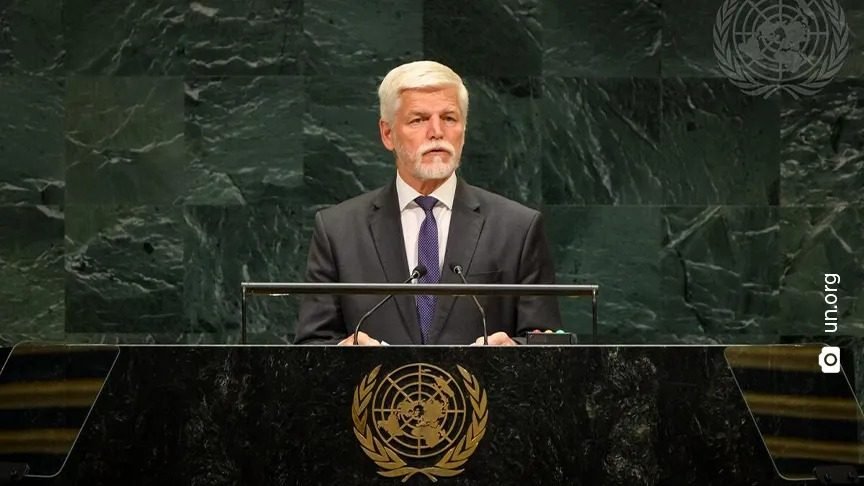
Czech President Petr Pavel on Wednesday warned of the risks posed by artificial intelligence, stressing that the technology must serve humanity and develop within the framework of international law.
In his address to the UN General Assembly in New York, Pavel said human beings “must remain” in control of technology, rather than become subject to it.
“AI can bring enormous benefits to humanity, but without effective safeguards, it can also cause immense harm,” he added.
Pavel said the world cannot allow an unchecked race for technological dominance to determine the future of AI, with pressure to move first pushing safety, oversight and responsibility aside.
Referring to the Manhattan Project, the World War II research and development program that produced the first nuclear weapons, Pavel said it demonstrated how rapidly a scientific breakthrough could transform the balance of power and how difficult it could be for politics and international rules to catch up.
Artificial intelligence confronts the world today with a different technology and different risks, he said, “but with a similar lesson: governance that comes only after the fact may come too late.”
“If AI is to serve humanity, it must develop within a framework of international rules … No country and no company can meet this challenge alone,” he added.
‘We need something that holds us together’
In his address, Latvian President Edgars Rinkevics said events occurring far away are “no longer far away.”
“Instability travels. Conflicts cross borders. What happens in Ukraine does not stay in Ukraine. What happens in the Middle East, in the Red Sea, in Sudan does not stay there,” he noted.
Rinkevics stressed that technology has made distance matter even less, saying artificial intelligence offers enormous opportunities but, in the wrong hands, can also become a “powerful tool for deception, disruption, and conflict.”
“And nature respects no borders either. Heat waves do not stop at checkpoints. Rising seas threaten to erase island nations,” said the president.
He added: “When we share the same boat, we need something that holds us together, and we already have it: the United Nations Charter and its principles.”
Situation in West Bank, Gaza remains of ‘great concern’
Estonian President Alar Karis, meanwhile, expressed concern over developments in the occupied West Bank and Gaza, saying the situation “remains of great concern.”
“Innocent civilians and children must not bear the devastating human costs of war,” he noted.
Karis reaffirmed Estonia’s commitment to a credible political process leading to a negotiated two-state solution with Israel and Palestine.
Highlighting the importance of cooperation among nations in addressing global challenges, he said greater disregard for international law and the principles of the UN Charter, reinforced by a sense of impunity, “too often dominates over adherence to the rule of law and cooperation between countries for a better future.”
“Aggression, wars, and conflicts is becoming the new normal,” he warned, arguing that the UN requires profound reforms to address the challenges of the 21st century.
Romania joins initiative launched by first ladies of Türkiye, US, Ukraine
Romanian President Nicusor Dan addressed social media manipulation, saying that if thousands of fake accounts speak in a coordinated manner, an individual’s voice is “no longer heard, and freedom of speech is denied.”
“And if thousands of fake accounts launch a coordinated attack on the ideas expressed by an individual, they discourage others from joining that person’s cause, and freedom of association is denied.”
Turning to the Russia-Ukraine war, Dan recalled that Romania, Türkiye and Bulgaria are members of the Mine Countermeasures Task Group in the Black Sea, established in response to disruptions to freedom of navigation.
“This initiative safeguards freedom of navigation and the region’s energy security. And in order to enhance security in the Black Sea area, Romania places particular emphasis on the EU strategic approach,” he added.
On Gaza, Dan said it is essential to advance the implementation of the peace plan for the enclave in accordance with UN Security Council Resolution 2803 and to address the humanitarian situation on the ground without delay.
“At the same time, recent developments in the West Bank are a genuine reason for concern and risk undermining the peace that this plan seeks to promote,” he noted.
On digital education and children’s safety, Dan said Romania had joined initiatives launched by Türkiye’s first lady Emine Erdogan, US first lady Melania Trump and Ukraine’s first lady Olena Zelenska aimed at building accessible education and creating a more innovative and safer environment for children.
Europe cannot be ‘mere observer’
In her address, Bulgarian President Iliana Iotova said the Russia-Ukraine war remains Europe’s main challenge, noting that its consequences have spilled “far beyond the immediate combat zone.”
“Europe, however, cannot be a simple, a mere observer, it must be a real participant in negotiations on the post-war security architecture of the continent after the end of the war,” she noted.
Iotova added: “Europe must be able to guarantee its own security.”
She said it would be “irresponsible” if, after the war in Ukraine ends, Europe were unable to offer “anything better to European citizens than a new Cold War or worse.”
During her speech, Iotova commemorated Marin Marinov, a 51-year-old Bulgarian UN worker who was killed in Gaza last year.
Iotova said Marinov “accomplished his humanitarian mission,” and called for creating the conditions needed for stabilization and reconstruction, “credible security assurances for Israel, and effective Palestinian governance.”
She added: “We remain convinced that the only sustainable solution is one in which the two states, Israel and Palestine, live side by side in peace and security.”



