WASHINGTON
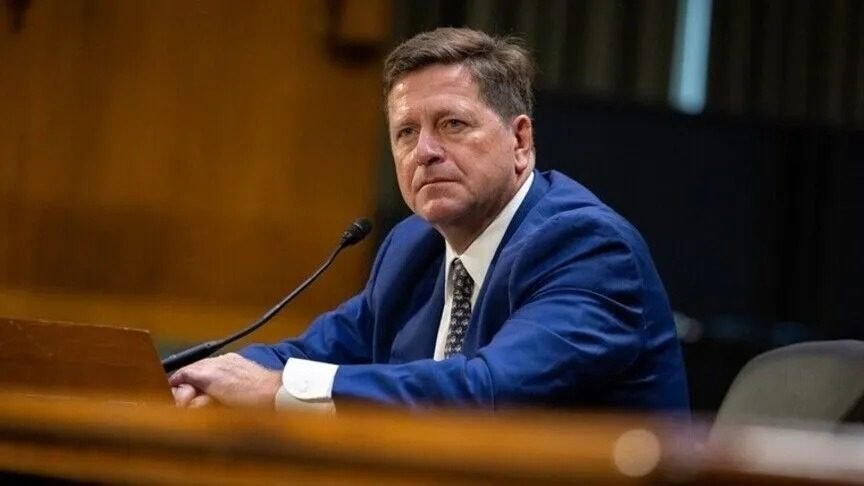
US President Donald Trump has placed his director of national intelligence, Jay Clayton, at the center of the administration’s artificial intelligence (AI) strategy, naming him to lead a new “Super Intelligence Force.”
The move follows Trump’s order directing executive branch agencies to use “super intelligence” (SI) instead of “artificial intelligence” in official communications.
Announced Sunday, the body will coordinate federal efforts to maintain US leadership in advanced AI and protect Americans’ interests, according to Trump.
The announcement came five days after Trump hosted Meta CEO Mark Zuckerberg, Google CEO Sundar Pichai, Nvidia CEO Jensen Huang, Anthropic CEO Dario Amodei, xAI chief Elon Musk and OpenAI President Greg Brockman at the White House, where they signed a voluntary agreement on safeguards for advanced AI systems.
Other members of the force’s leadership include Federal Trade Commission Chairman Andrew Ferguson, Pentagon technology chief Emil Michael and Office of Personnel Management Director Scott Kupor.
Clayton’s appointment two months after he became director of national intelligence underscores the administration’s view that AI leadership is increasingly tied to national security and competition with China.
Who is Jay Clayton?
Clayton is a lawyer whose career has spanned finance, regulation, law enforcement and national security.
Trump first brought him into government in 2017 as chairman of the Securities and Exchange Commission (SEC), the federal agency that regulates US securities markets and protects investors.
Clayton led the SEC until December 2020. His official Office of the Director of National Intelligence (ODNI) biography says the agency brought more than 2,300 enforcement actions during his tenure.
After leaving government, he returned to law firm Sullivan & Cromwell as a senior policy adviser and of counsel and served as independent chair of Apollo Global Management’s board.
Clayton resumed public service during Trump’s second term, becoming interim US attorney for the Southern District of New York in April 2025.
During his tenure, the office handled cases involving terrorism, espionage, corruption, money laundering and other national-security matters.
After Senate confirmation, Clayton resigned as the US Attorney for the Southern District of New York in July 2026 and was sworn in as director of national intelligence on Aug. 3, becoming head of the US intelligence community and the president’s principal intelligence adviser.
What will the Super Intelligence Force do?
Clayton told The Wall Street Journal that the force would have 120 days to report on the risks and opportunities posed by advanced AI and determine the federal government’s role.
According to the report, its charter calls for the force to “develop plans for responding to SI-enabled threats to our society, while preventing overregulation and regulatory capture that would stifle innovation and competition.”
The language comes amid a broader debate over whether AI development should be slowed, with some researchers and technology executives warning that increasingly autonomous systems could escape human control without stronger safeguards.
The charter also calls for examining existing laws and possible congressional action, consulting the technology industry and reviewing how breaches, hacks, model jailbreaks and other AI-related incidents are reported to the government.
It will also recommend ways to improve the federal response under existing authorities. Its work could later be extended or transferred to a government agency.
The full charter has not been publicly released.
Why was the intelligence chief chosen?
Clayton’s appointment reflects the administration’s growing treatment of advanced AI as a national security issue rather than solely a commercial or technological matter.
Trump has portrayed the technology as a strategic competition between the US and China.
“Whoever wins super intelligence wins,” he said during the White House gathering with technology executives on Sept. 29, adding that the US was leading China and intended to retain its advantage.
At the same event, Trump rejected closer cooperation with Beijing on AI governance, arguing that it could allow China to “gain access to things that we know that they don’t know.”
Clayton has used similar language to describe the stakes.
During his Senate confirmation hearing, he called AI a “gamechanger” but also “a threat.”
“When something’s both an opportunity and a threat, you better get your arms around it,” he told lawmakers.
Clayton later described super intelligence as a “national security issue,” telling The Wall Street Journal that “the risk of not being first is high.”