
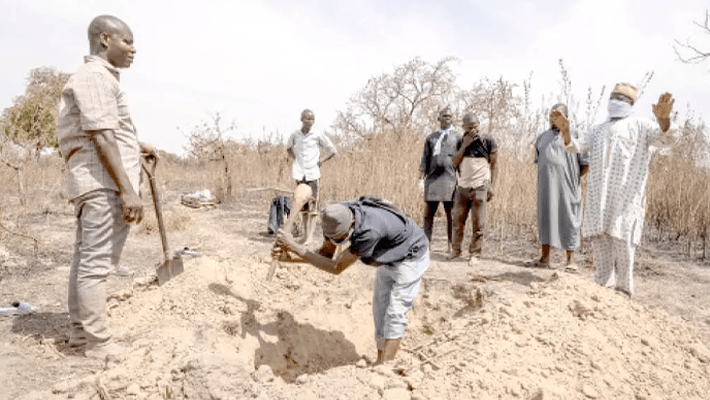
Survivors of the Boko Haram terrorist attacks on Woro and Nuku communities in Kiama LGA of Kwara have decried the brazenness with which their attackers killed innocent residents.
Residents, who spoke to Peoples Gazette on Thursday, said the terrorists had a free day when they stormed the communities at exactly 5:30 p.m. on Tuesday and operated unhindered till the early hours of Wednesday when they called residents for morning prayer.
“No one was aware of their coming. They just entered and started shooting. What we knew was that they sent a letter to the emir, who later informed soldiers before the attacks. The soldiers arrived in the communities last Friday and spent just one hour there. Not until Tuesday evening, when the terrorists stormed the villages,” Abdulkareem Tajudeen to The Gazette.
Adamu Abdullahi told The Gazette he had become distraught, struggling to be stable emotionally since the vicious attack.
“The attack lasted for about 17 hours. No help from them (security agencies). Woro is a few minutes’ ride from Kainji and Wawa, which have military barracks. But none came for help. It is unfortunate. The police, like other security agencies, have demonstrated unprofessionalism; one that I have never seen in my entire existence,” Mr Abdullahi stated.
Funeral for 200, death toll rising
Mr Tajudeen said as of Thursday evening, over 200 dead bodies had been recovered and buried amid ongoing search efforts for more missing bodies in the bush.
“The number we count is over 200. Even to date (Thursday), they are still bringing dead bodies from the bush. The dead bodies that we buried are over 200. People burying them are even tired. There are bodies not buried yet,” he added.
Aminu Sadiku stated that the number of casualties remains uncertain, as the number of deaths kept increasing, adding that the village had been completely deserted for fear of further attacks despite the heavy presence of security.
“As for the exact number of casualties, no one can be certain for now,” Mr Sadiku disclosed to The Gazette. “The terrorists burnt houses, shops, vehicles and destroyed almost everything. As I am talking to you, several bodies have been buried. Some are still there as search efforts for more dead bodies continue.”
Meanwhile, government officials pegged the number of buried casualties to 75, citing estimates attributed to the Emir of Kaiama, Salihu Omar, during a visit to the palace by Governor Abdulrahman Abdulrazaq on Thursday.
Although the police command in Kwara confirmed the attack, it was silent about the number of people killed. However, a statement by police spokesperson Adetoun Ejire-Adeyemi on Thursday said the command had launched a full-scale investigation into the incident.
“A joint operation involving the police, the military and the National Forest Guards has been activated in the area”, Ms Ejire-Adeyemi stated.
A failed state?
Many Kwara residents, especially in the northern parts of the state, attributed the perennial terrorist attacks to the failure of the government.
Sanusi Lafiagi, a lecturer and good governance advocate, said the recent attacks on Kiama communities showed the security challenges plaguing the North-Central state had taken a dangerous dimension.
“For quite some time now, peace and quiet appear to have returned to the communities which had hitherto suffered terrorist attacks until the recent incident,” Mr Sanusi told The Gazette on Thursday. “What this indicates is that we are not out of the woods yet on these violent attacks on innocent and peace-loving people of Kwara State.”
The academic noted that for the attackers to operate with such brazenness and for so long without being repelled or suppressed indicated the failure of the government.
“For how long will our people continue to suffer such ill-fate, and live in constant fear of attacks? The government needs to sit up and prevent these violent crimes from happening. Enough of excuses, promises, and condolence visitations. Concrete actions must be taken to forestall such occurrences in the future,” he stated.
Musa Idris Buko, who chairs the Coalition of Kwara North Groups, described the attacks as the worst of all the deadliest terrorist attacks in the state so far.
“The Tuesday 3rd February 2026 attack on Woro community of Gwanabe Ward I in Kaiama LGA remains the worst so far of all the deadly attacks in Kwara state, with over 200 deaths recovered and with certainty that it would rise,” Mr Buko stated.
He stated that some of the victims were killed and thrown in the river, others in the bush, while others were burnt in their houses.
“So, this is a catastrophe, to say the least. This is not the first time we recorded attacks in Kwara North,” Mr Buko stated. “From Kaiama, Baruten, to Patigi and then to Edu LGAs. Only Moro LGA has been largely peaceful.”
Global outrage
Several international bodies, including the United Nations, the African Union and the Organisation of Islamic Cooperation, slammed the dastardly attacks as unwarranted and unconscionable.
The UN secretary-general António Guterres, in a statement, expressed solidarity and readiness to support President Bola Tinubu’s efforts to combat terrorism.
“The secretary-general reiterates the solidarity of the United Nations with the Government and people of Nigeria in their efforts to fight terrorism and violent extremism and stresses the importance of bringing the perpetrators to justice,” the statement said.
Similarly, the AU Commission’s chairperson, Mahmoud Ali Youssouf, on Thursday, described the attack as barbaric and heinous.
“It constitutes a grave violation of human rights and an unacceptable assault on peace and security,” stated Mr Youssouf.
Mr Youssouf expressed the African Union’s “full solidarity with the government of Nigeria and the authorities of Kwara State during this difficult time”.
The OIC, in a statement on Thursday, also commiserated with families of victims, the Nigerian government, as well as the Nigerian people, declaring its support for the Nigerian government in combating the spate of terrorism in the country.
How to stop the terrorists
Amid efforts to curtail insecurity across different parts of the country, residents advised governments at all levels to investigate the root causes of the killings and change tactics for successful outcomes.
Mr Buko, a former Baruten/Kaiama federal constituency House of Representatives candidate, stressed the urgent need for the governments to embrace a holistic approach in combating terrorism beyond the usual kinetic strategies.
“Beyond the kinetic measures of bombing, killing the terrorists and then they attack again, while authorities act reactively, it is very important to look into the root causes and change tactics,” the politician explained. “In order to ensure the safety of lives and properties in a sustainable manner, governments should adopt a holistic policy approach to decisively deal with the root causes of insecurity in Nigeria. I am afraid much has not been done in this regard.”
Mr Lafiagi also reminded the government to live up to its responsibility to protect lives and property, as required by the constitution.
The academic advocated, among others, the need to improve our intelligence gathering by working closely with the locals; equip the locals with technological devices that will enable them to report security threats in their area promptly to security operatives for quick response and intervention; and equip local vigilantes with sophisticated weapons to protect their communities and repel attacks while waiting for military intervention.
SOURCE: PEOPLES GAZETTE



