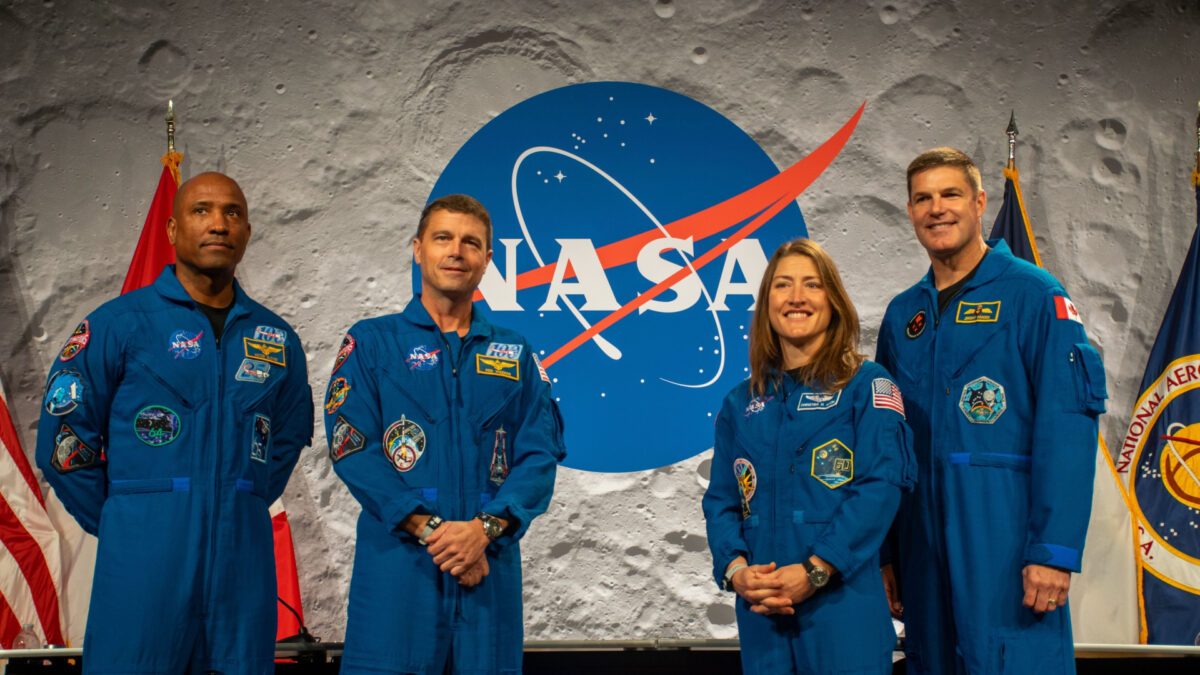
Four astronauts safely returned to earth on Friday after completing the first lunar flyby in more than 50 years.
NASA on Friday celebrated a successful voyage around the moon, after its spacecraft carrying four astronauts—three Americans and one Canadian—landed without a hitch off the California coast, capping the U.S. space agency’s crewed test mission that returned with spectacular images of the moon.
“What a journey,” said mission commander Reid Wiseman, who reported that the crewmembers — himself along with Christina Koch, Victor Glover and Jeremy Hansen — were “stable” and “green.”
“They’re in great condition, that’s what that means,” said Rob Navias, the NASA public affairs official who narrated their return on the agency’s livestream.
NASA officials and the U.S. military helped extract the astronauts from the bobbing capsule — to the applause of those watching from mission control.
According to the AFP, by late Friday, helicopters had lifted the astronauts to a recovery ship off the Pacific coast near San Diego, where they all proved capable of walking unassisted.
NASA administrator Jared Isaacman called the voyage “a perfect mission.”
“We’re back in the business of sending astronauts to the moon,” he said, and “this is just the beginning.”
As the astronauts returned to earth, their spacecraft reached maximum speeds more than 30 times the speed of sound, and faced searing temperatures around half as hot as the surface of the sun.
It was a key test of their heat shield, which, in an earlier trial, an uncrewed mission had faced complications that they attempted to mitigate this time round by shifting the return trajectory.
“If you didn’t have anxiety bringing this spacecraft home, you probably didn’t have a pulse,” said flight director Rick Henfling.
While the Artemis II re-entry was smooth sailing, the Orion capsule will now be painstakingly examined to assess how it fared.
U.S. President Donald Trump praised the astronauts for their “spectacular” trip and said he “could not be more proud” — while wasting no time in looking ahead to the eventual goal of sending missions even further into space.
“Next step, Mars!” Mr Trump wrote on social media.
Artemis II was the inaugural crewed mission of NASA’s programme aiming to install a sustained presence on the moon, including the eventual construction of a base that could be used for further exploration, including to mars.
From liftoff to splashdown, the trip clocked in at nine days, one hour, 31 minutes and 35 seconds — though NASA rounds up and calls it a 10-day mission.
It began with a launch from Florida on April 1 2026, and was studded with several firsts, records and extraordinary moments.
The four astronauts became the first humans to travel furthest away from the Earth, at 252,756 miles (406,771 kilometres).
While hurtling through deep space and zipping around the moon, they took thousands of photographs, amassing a stunning portfolio of images that captivated people on earth.
The astronauts also witnessed a solar eclipse along with extraordinary meteorite strikes on the lunar surface.
Several achievements added to the voyage’s historic nature: Glover was the first person of colour to fly around the moon, Koch was the first woman, and Canadian Hansen was the first non-American.
Astronomer Derek Buzasi of the University of Chicago called the mission “an almost flawless success.”
“I admit to having had my doubts about the Artemis program, but now I have fresh confidence in our next steps as we go back to the moon to stay,” he told AFP.
NASA is hoping it can put boots on the lunar surface as soon as 2028 — the final full year of Trump’s second White House term.
Experts, however, voiced scepticism that the lunar landers being developed by SpaceX and Blue Origin, companies owned by billionaires Elon Musk and Jeff Bezos, respectively, would be ready in time.
Meanwhile, China is forging ahead with its own effort targeting 2030 to put astronauts on the moon.