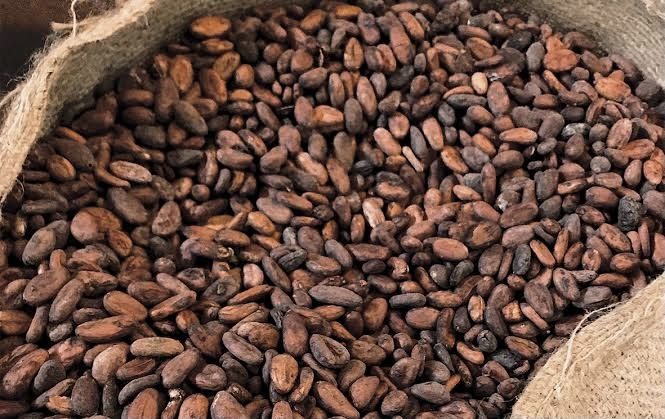
Cocoa farmers in Ondo, Osun and Ekiti States have lamented the massive crash in cocoa bean prices, which they claim has plunged many into financial despair and cut deeply into their livelihoods.
The farmers, in separate interviews with journalists on Sunday, claimed the price reversal from boom to bust has left many with significant debt and, in some cases, unable to find buyers for their harvests.
They stated that what began as a windfall for cocoa farmers in 2024 had spiralled into a full-blown income shock, as prices had fallen by over 70 per cent from historic highs, creating fears of mass farm abandonment and a visible human toll at the farm level.
Abiodun Joseph, a young cocoa farmer in Owo, Ondo State, said the sharp decline in cocoa bean prices had frustrated and discouraged many young farmers from continuing in cocoa farming.
“As of January 2025, cocoa was sold for N14,500 per kilogramme, but now it has dropped to between N2,500 and N2,000 per kilogramme. As of now, it is difficult for an average farmer to cope with the standard of living based on the sharp price decline.
“Many farmers are finding it difficult to maintain their farms to get the desired output. Unfortunately, many young farmers are being discouraged from going further into cocoa farming,” said Mr Joseph, who has over 12 years of experience in cultivating cocoa.
Similarly, Olanrewaju Abiodun, a local buying agent in Akure, lamented that the plummeting price has affected everyone in the cocoa business chain, with many dealers going out of business due to losses.
Mr Abiodun advocated the establishment of a National Cocoa Management Board to regulate the sector, stabilise producer incomes, and determine cocoa prices in the country.
Similarly, David Ogunmakinwa, a cocoa farmer in Ile-Oluji, called on the government to subsidise insecticides, pesticides, fertilisers, and other essential farm inputs to support young farmers facing high production costs.
Mr Ogunmakinwa, who owns cocoa plantations in Ojokopoun camp, Awaye village and Lota camp in Ile-Oluji/Okeigbo Local Government Area of Ondo State, noted that some farmers are facing “nightmare situations” due to mismanagement or poor resource utilisation.
“Although there are some farmers who misused the money raked in during the booming era, young farmers should endeavour to invest heavily in their farms and keep faith in cocoa farming,” Mr Ogunmakinwa stated.
A cocoa farmer in Okitipupa, Kola Akinmoye, observed that many youths who came from the city to tap into the cocoa boom when prices were high had abandoned their farms, leaving original cocoa farmers to bear the consequences.
“We don’t know what was responsible for the drop in the prices of cocoa, but it’s having an adverse effect on our finances and daily activities. We urge the government to help us and subsidise the inputs as well as help us so that cocoa can return to former prices for farmers to regain their losses,” Mr Akinmoye said.
Jimoh Aderinigbe, another cocoa farmer in Ore, Odigbo Local Government, also said the drop in cocoa prices had put lots of cocoa farmers in debt, especially those who took loans to plant and process their cocoa seeds.
“Many cocoa farmers, especially those ones who were on loans, are on the verge of death. We’re appealing to the government to come to our aid so that we don’t record casualties,” Mr Aderinigbe said.
Similarly, in Osun, the state chairman of the Cocoa Growers Association of Nigeria, Adewale Abimbola, said farmers were unaware of the factors behind the recent drop in global cocoa prices.
He, however, explained that fluctuations in cocoa prices are not unusual, as the commodity had historically experienced periodic changes, and identified the lack of local processing as a major challenge affecting cocoa pricing in Nigeria.
“If Nigeria exports processed cocoa instead of raw produce, farmers will have greater control over pricing. The higher or lower exchange rate determines the gain or loss cocoa farmers will make. Foreign exchange volatility remains another obstacle to price stability,” he said.
Similarly, a cocoa merchant, Kolade Afeez, attributed the high prices to weather conditions, international market forces, and high temperatures across cocoa-producing regions over the past two years.
He explained that the recent decline in prices, alongside the naira’s appreciation from about N1,600 to N1,390 per dollar between 2025 and 2026, had negatively affected farmers’ earnings.
Mr Afeez also noted that the influx of new entrants into cocoa farming during the period of high prices led to increased supply, which has now contributed to the decline in prices.
In Ekiti, an Ido-Ekiti-based young cocoa farmer, Moses Ojo, said the sudden drop in cocoa prices had deprived him of over N2 million in gains in the current harvest, as against the bumper gains in previous harvests.
Mr Ojo, a former secondary school teacher, said he resigned to invest in his late father’s cocoa farm.
The coordinator of the All Farmers Association of Nigeria (AFAN) in Ido-Osi Local Government, Olutayo Owoeye, described the sudden price drop as a major setback for farmers.
“We may be heading for serious consequences, as our cocoa farmers have vowed to cut down their cocoa trees and replace them with other viable alternative crops or commodities if the downturn in cocoa prices continues and no assurances are given that their investment will be protected.
“This is coming at a time the sector is already weakened by ageing plantations, chronically low yields and intensifying climate variability,” he said.
He said the association was rallying around and taking proactive measures, including financial support, to help affected cocoa farmers alleviate the negative impact of the sudden price drop.
An Agricultural expert, James Yahaya, argued that the crash in cocoa prices was the result of a market correction following the historic global price surge driven by supply shortages in West Africa.
Mr Yahaya said the prices reduced global demand due to high chocolate prices, inflation, and weakened consumer purchasing power, as well as increased local production from farm expansion and favourable weather in some regions.
He said one measure to protect farmers’ investments and reduce rural-urban drift is to establish minimum price guarantees and functional commodity boards. He suggested strengthening farmers’ cooperatives for better market access and bargaining power, and promoting contract farming and forward pricing arrangements.
Meanwhile, the Ekiti Commissioner for Agriculture and Food Security, Ebenezer Boluwade, said the state government had developed a 10-year policy plan to position the state among the top three cocoa-producing states in Nigeria.
“The Ekiti State government has maintained its commitment to supporting farmers, aiming to boost local production through the distribution of 500,000 improved seedlings for the 2025/26 season, supported by the United States Department of Agriculture (USDA) TRACE Project.
“The state has provided 50 per cent subsidies on agrochemicals, 50 per cent subsidy on improved seedlings, and free fertiliser to farmers to improve yield efficiency despite market instability.
“The Ekiti State government, in partnership with the TRACE Project, has presented irrigation pumps worth about N10 million to 28 cocoa nursery operators across local government areas of the state. The beneficiaries had undergone training on best practices in raising cocoa seedlings to boost cocoa production in the state,” he said.
According to him, the state will require about 10 million cocoa seedlings to achieve the target, which informed the decision to train and empower cocoa nursery operators to produce quality seedlings for farmers.
(NAN)