BOGOTA
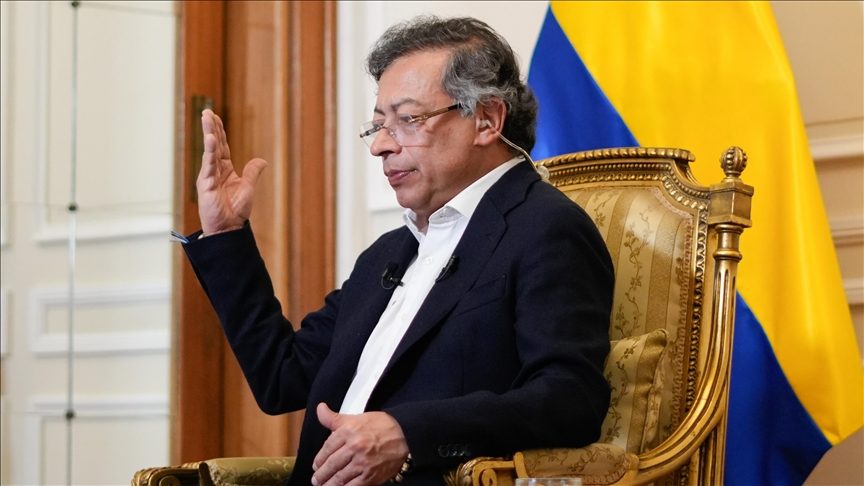
Colombian President Gustavo Petro on Monday rejected remarks linked to US President Donald Trump and accusations by Secretary of State Marco Rubio, reaffirming his constitutional authority, defending his government’s anti-narcotics policy, and warning against foreign interference in Colombia’s sovereignty.
“As for Mr. Rubio, who separates authorities from the president and claims that the president does not want to cooperate while the authorities do, I ask that he read the Constitution of Colombia, because his information is completely erroneous,” said through US social media company X.
His remarks came after the US launched a pre-dawn raid on Venezuela on Saturday, capturing its president and the first lady, who were later flown to New York.
Petro alleged that such narratives were driven by Colombian political interests tied to organized crime and aimed at damaging bilateral relations with Washington.
“They want a rupture in relations between the United States and Colombia so that cocaine trafficking explodes worldwide,” he said.
Petro added that he had ordered the removal of several police intelligence colonels for allegedly providing false information against the state, warning against reliance on what he called “fallacies.”
Reaffirming his authority, Petro stressed that the Colombian president is constitutionally designated as the commander-in-chief of the armed forces and police under the 1991 Constitution, drafted after the M-19 movement—of which he was a member—laid down arms and participated in a democratically elected Constituent Assembly.
He highlighted his administration’s anti-narcotics strategy, saying it had delivered the largest cocaine seizure in history, halted the expansion of coca cultivation, and launched a voluntary crop substitution program covering 30,000 hectares, which he described as a top policy priority under his direct leadership.
Petro said security forces had reclaimed Plateado in the Cauca department—an area he labeled “the Wall Street of cocaine”—and conducted military operations in compliance with international humanitarian law, resulting in the capture and killing of senior leaders of armed groups linked to drug trafficking.
He accused such groups of recruiting minors to deter airstrikes.
“If you bomb even one of these groups without sufficient intelligence, you will kill many children,” he warned. “If you bomb peasants, thousands of guerrillas will rise in the mountains.”
‘Colombia free forever’
Petro also cautioned against any attempt to detain him. “And if you detain the president—whom a large part of my people loves and respects—you will unleash the popular jaguar,” he said.
“Any commander of the public force who prefers the US flag over the Colombian flag will be immediately removed from the institution,” he said, citing constitutional obligations to defend popular sovereignty.
Although not a career military officer, Petro said he had firsthand knowledge of conflict and reaffirmed his commitment to peace, while warning he would defend the country if necessary.
“I swore never to touch a weapon again after the 1989 peace pact, but for the homeland I will take up arms again—arms I do not want,” he said.
Petro rejected allegations questioning his legitimacy or integrity, stating that his finances were transparent and limited to his presidential salary. “I am not illegitimate, nor am I a narco,” he said.
He concluded by urging Colombians to defend democratic institutions against what he described as illegitimate violence and reaffirmed his confidence in the people, the armed forces, and Colombia’s history.
“So know that you are facing a commander of the people,” Petro said. “Colombia free forever.”