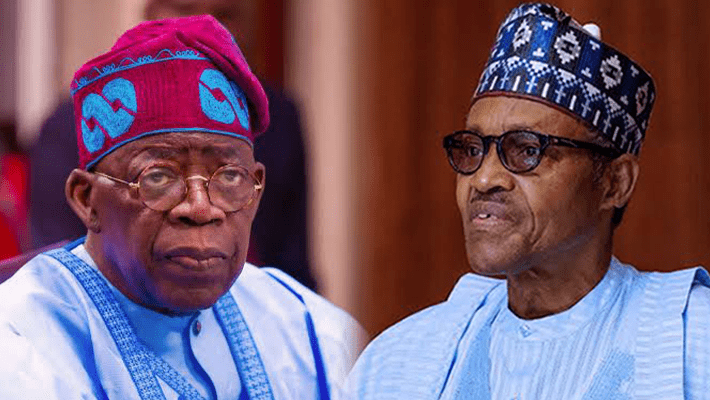
Nigeria’s ambassador-designate to the United Nations, Senator Jimoh Ibrahim, has said it is unrealistic for President Tinubu to instantly fix inflation caused by the printing of ₦30 trillion through Ways and Means by the administration of the late President Muhammadu Buhari.
Mr Ibrahim said Mr Tinubu met 0.5% cash-to-GDP when he assumed office, but refused to expose the financial recklessness that took place during Mr Buhari’s tenure.
“Buhari printed ₦30 trillion; so you want Tinubu to do magic to replace that ₦30 trillion?,” Mr Ibrahim said during an interview on Channels TV’s Politics Today on Friday.
He noted that he advised the President to expose details of the reckless printing of naira and borrowings done by the ex-President, but members of Mr Tinubu’s cabinet advised against it.
“When Bola Tinubu came in, I told him, ‘Sir, let us publish the data that we’re inheriting,’ but people said, ‘Because we’re in the same political party, it will cause some distractions.’ Bola Tinubu met just 0.5% cash-to-GDP,” Mr Ibrahim said.
The Minister of Finance and Coordinating Minister of Economy, Wale Edun, had earlier lamented that Mr Buhari’s regime caused Nigeria’s hyperinflation by aimlessly printing trillions of naira.
In March 2024, Mr Edun told the Senate Committee on Finance that the trillions of naira printed by the Central Bank of Nigeria through Ways and Means overdraft for the Federal Government from 2015 to 2023, under Mr Buhari threw the country into the current inflation.
The minister said during the period, the printing of naira in trillions was carried out without any corresponding productive activities.
According to him, the consequence of the eight years of printing money without productivity is the high inflation confronting the country now.
“The N22.7 trillion printed by the Central Bank of Nigeria (CBN) through Ways and Means overdraft for the federal government from 2015 to 2023 landed Nigeria into hyper-inflation,” Mr Edu told the Senate Committee on Finance in March 2024.
He lamented that for eight years, Mr Buhari’s regime printed money without commensurate productivity, adding that “We are going to audit even the N22.7 trillion printed aimlessly.”
“We talked about inflation. Where has it come from? It came from eight years of just printing money not matched by productivity,” Mr Edu said.
“What happened was that for eight years, the weak were left to their own devices. It is the privileged few that took everything. That is the reality. So that money supply must be brought back,” he added.
Mr Tinubu succeeded his party man, Mr Buhari, in office on May 29, 2023. With inflation at 22 per cent, Mr Buhari, who presided over the country for eight years, from 2015-2023, bequeathed a debt profile of over N46 trillion, according to Debt Management Office, to Mr Tinubu.
Though the rising cost of living and food prices predated Mr Tinubu’s government, they assumed a worrisome dimension since he assumed office and ended the fuel subsidy regime including floating the naira.
Meanwhile, Mr Ibrahim on Friday, said Nigeria stood to gain economically, particularly in relation to oil and energy markets, from the ongoing U.S.-Israeli war with Iran.
Asked during the interview by how the conflict could affect Nigeria in terms of grains and energy, Mr Ibrahim stated that rising oil prices could strengthen Nigeria’s economy.
He stated, “You will have more money; that’s one thing. It will reduce borrowing. The price of the dollar may initially rise, but when you sell more oil at higher prices, you get more dollars.
“That allows the central bank to intervene in the black market and stabilise rates, making dollars more available. Once that happens, the macroeconomic effect will improve because price stability promotes a sustainable economy arising from cash inflows, not borrowed funds.”
He also highlighted the progress in Nigeria’s debt management under Mr Tinubu’s administration.
“Right now, revenue-to-debt servicing is 68%. Kudos to Bola Tinubu. Before he came, a 96% GDP-to-revenue ratio went to debt management, meaning for every 100 naira, 96 naira went to debt. Now, you save about 38 naira in your pocket.
“With oil prices almost doubling, Nigeria has more dollars to stabilise the macroeconomic system. So, I don’t think there will be much of a problem,” he said.
He added that the conflict could result in higher domestic costs, particularly for transportation, due to rising fuel prices.
“Nigeria is a member of the geocentric system and cannot isolate itself. The government is considering policies to cushion potential impacts. They are capable of doing this because they are receiving significant revenue from crude oil,” he said.
Crisis escalated in the Middle-East after the United States and Israel attacked Iran on February 28, 2026, targeting Iranian leadership and infrastructure, and killing Iran’s Supreme Leader, Ali Khamenei and members of the Iranian government.
The conflict, now entering its third week, has claimed more than 1,300 civilians in Iran, displaced around 3.2 million people.
The crisis caused global oil prices to surge above $100 per barrel as Iran blocked the Strait of Hormuz, a major route for crude shipments.
The disruption affected Nigeria, pushing domestic petrol prices to between ₦1,075 and ₦1,165 per litre, potentially impacting transport and food costs.
The late Mr Khamenei has since been succeeded by his son, Mojtaba Khamenei. But the U.S. government on Friday placed $10 million bounty on Mr Khamenei jr. and leaders of the Iranian Revolutionary Guards.