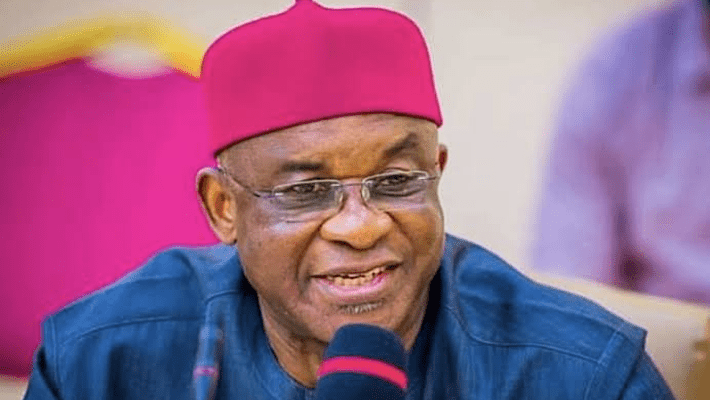
The national chairman of the African Democratic Congress (ADC), David Mark, has called on the leadership of the National Assembly to allow the Independent National Electoral Commission (INEC) to determine whether or not it can electronically transmit election results.
Mr Mark specifically warned the Senate, led by Godswill Akpabio, against usurping the powers of the electoral body ahead of the 2027 general election.
He explained that INEC, as the body constitutionally empowered to conduct elections, is in the best position to assess its capacity and deploy technology suitable for credible polls in the country.
Mr Mark, a former Senate president, spoke on Saturday during the public presentation of The Burden of Legislators in Nigeria at the NAF Conference Centre, Abuja.
“There should be electronic transmission. Let INEC decide whether they can do (real-time electronic transmission), or they cannot do it. Don’t speak for INEC. Just speak for the National Assembly.
“And what the public wants is, let there be electronic transmission of election results, and now if INEC cannot do it. It’s in their own problem, not for you to speak for INEC…(sic),” Mr Mark said.
His remarks come amid mounting criticism from civil society organisations, opposition parties, and pro-democracy groups over the Senate’s refusal to make real-time electronic transmission of results mandatory in the ongoing review of the Electoral Act.
Last week, the Senate passed the Electoral Act, 2022 (Repeal and Re-enactment) Bill, 2026, but rejected an amendment to allow electronic transmission of polling unit results.
Instead, the federal lawmakers retained the existing framework, which permits manual completion, signing, stamping, and physical transfer of results in line with procedures prescribed by INEC.
Several critics have said that retaining manual collation leaves room for manipulation and could undermine electoral transparency, potentially reversing gains made in recent elections.
However, some federal lawmakers have defended their position, citing poor network coverage in rural communities and logistical challenges as reasons compulsory electronic transmission may not be feasible nationwide.
Mr Mark’s intervention adds to the growing pressure on the National Assembly to strengthen, rather than dilute, electoral reforms ahead of the next general elections.