
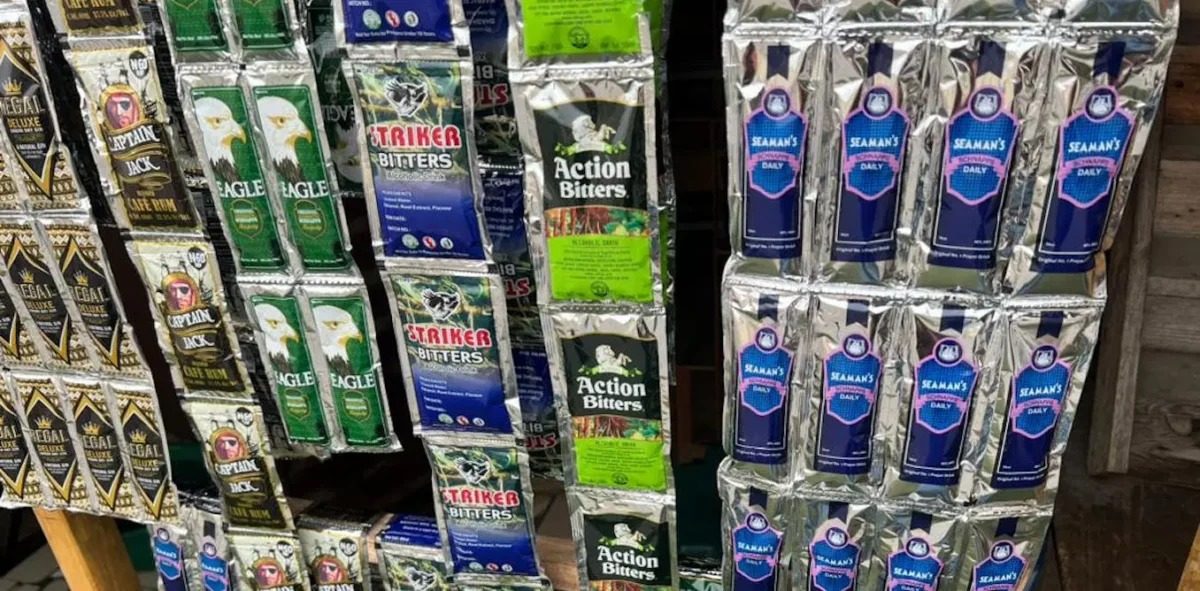
The director-general of the National Agency for Food and Drug Administration and Control (NAFDAC), Mojisola Adeyeye, says the ban on alcohol in small pack sizes remains the best solution to tackle underage drinking.
Ms Adeyeye said this at a news conference in Abuja on Tuesday to mark the commencement of the enforcement of the nationwide ban on sachet alcoholic drinks.
Enforcement would be carried out by the NAFDAC, the National Orientation Agency (NOA), and the Federal Competition and Consumer Protection Commission (FCCPC).
Ms Adeyeye said several studies showed a rapid increase in alcohol availability, production, importation, and consumption across age groups in recent decades.
“In 2018, the Association of Food and Beverage and Tobacco Employers (AFBTE) and the Distillers and Blenders Association of Nigeria (DBAN) took NAFDAC to the Ministry of Health and Social Welfare to say that we were trying to reduce the concentration of alcohol in sachets. By that time, it was like 50 per cent in the sachet,” she explained.
Ms Adeyeye said DBAN and AFBTE claimed their businesses would be destroyed, adding that the then minister of health gave these trade groups five years to reorganise their businesses.
She recalled that NAFDAC began the enforcement on February 1, 2024, but the groups dragged them before the Committee on NAFDAC at the National Assembly, which “told us to suspend what we were doing in 2024. It went back and forth throughout 2024.”
“In December 2024, the Minister of Health, Prof. Pate, said we should give an extra year, and we gave it,” she said.
The NAFDAC DG said the agency began enforcement following the Senate’s order, and trade groups also sought another extension.
She said NAFDAC was asked to conduct a survey to see the impact of alcohol on children, noting, “It was conducted in 2021 during the pandemic.”
Ms Adeyeye said that about 2,000 respondents were sampled across the six geopolitical zones, and the results were damning for the country.
She said findings showed that 54.3 per cent of minors and underage people obtained alcohol by themselves from various sources, while 49.9 per cent patronised retailers selling sachets and PET bottles.
The NAFDAC boss said 50 per cent of children drink alcohol, with findings suggesting that minors and underage also drink from friends, relatives, and social guardians.
“Of those who procure drinks for themselves, 47.2 per cent of minors and 48.8 per cent of underage people procure drinks in sachets because it is easy to conceal.
The survey data revealed that 63.2 per cent of minors and 54 per cent of underage people drink alcohol occasionally, while 44.3 per cent and 38.3 per cent of adults drink alcohol occasionally and daily, respectively.
“So, they even drink it more than adults because it is easy to conceal. Additionally, 9.3 per cent of minors and 25.2 per cent of underage children consume alcoholic beverages. And 11.3 per cent of minors and 9.4 per cent of underage consumers consume alcohol at least once a week. As young as nine years old, in this survey, consume alcohol,” she said.
On the pattern of alcohol consumption and abuse by minors and underage children, the survey findings revealed that about 11.7 per cent of underage children have ever engaged in binge drinking.
“This is mostly reported in Gombe. In terms of the most use of alcohol, it is Lagos State and Rivers,” she said.
Mr Adeyeye warned that alcohol could damage the hippocampus, memory centre in the brain and prefrontal cortex, leading to permanent issues with learning, memory and impulse control.
“Youth who begin drinking before age 15, the minors and underage in our study, are 41 per cent more likely to become dependent on alcohol. And this study also shows that they graduate to start taking cocaine and other narcotics,” she said.
According to her, it also contributes to academic problems because drinking often leads to lower grades, missed classes, and impaired cognitive function.
“In our country, it is responsible for banditry. It is responsible for kidnapping. You cannot be in your right mind and point a gun at somebody. It starts with alcohol and then goes on to hard drugs,” she said.
The NAFDAC DG said that due to the menace, the Senate made its resolutions on November 6, 2025, and they were communicated to the Secretary to the Government of the Federation (SGF) on December 1, 2025.
She said the resolutions urged NAFDAC not to grant further extension to the moratorium and to ensure immediate strict enforcement of the ban.
“It urges the Federal Ministry of Health and Social Welfare to release its national alcohol policy that includes the prohibition of alcohol in sachets and small volumes of less than 200mls.
“It urges the National Orientation Agency and NAFDAC to collaborate and intensify nationwide sensitisation of the dangers of alcohol in sachets and small-volume bottles,” she said.
Earlier, FCCPC’s spokesperson, Ondaje Ijagwu, said the commission would subject offenders in the food and drug sector to the offences and penalties based on the extant laws.
“By the time we begin implementation, which we are commencing immediately, Nigerians will know,” Mr Ijagwu said.
The director-general of NOA, Lanre Onilu, said the decision is a deliberate public health intervention aimed at reducing underage access to cheap, high-concentration alcohol and curbing the alarming pattern of harmful consumption across communities.
(NAN)



