
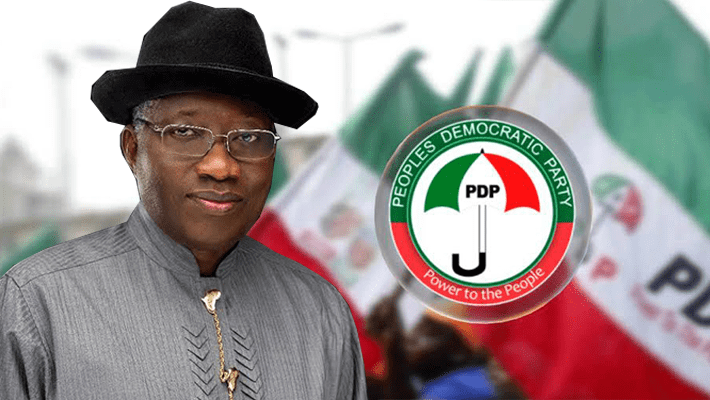
The screening committee of the Taminu Turaki-led Peoples Democratic Party (PDP) has waived the screening process for former President Goodluck Jonathan.
The chairman of the screening committee announced the development on Tuesday.
“He was a deputy governor, a governor, a vice president, and president, so he is qualified and there’s no need screening him, so we’re giving him a waiver,” the chairman said.
Mr Jonathan earlier said he would commence consultations concerning the possibility of contesting presidency in 2027.
Meanwhile, there’s an ongoing case at the Federal High Court, Abuja Division, contesting Mr Jonathan’s eligibility to contest presidential election in Nigeria.
The suit was heared on Monday, May 18, and adjourned until Tuesday, May 26 for judgment.
The suit, marked FHC/ABJ/CS/2102/2025, was filed by a lawyer, Johnmary Jideobi, who asked the court to declare Mr Jonathan constitutionally ineligible to seek the country’s apex position, having being sworn-in as president twice in 2010 and 2011.
Mr Jonathan is listed as the first defendant in the suit, while the Independent National Electoral Commission (INEC) and the Attorney-General of the Federation are named as second and third defendants respectively.
However, the plaintiff — Mr Jideobi has not appeared in court in the last three proceedings.
Mr Jideobi is seeking an order restraining Mr Jonathan from further presenting himself to any political party as a candidate for any presidential election in Nigeria.
He argued that Mr Jonathan had exhausted the constitutional limit for an individual to be in office as president after being sworn-in to complete the tenure of the late President Umaru Yar’Adua and subsequently being sworn-in to serve a full four-year term following the 2011 election.
The lawyer also asked the court to stop INEC from accepting, processing or publishing the former president’s name as a presidential candidate.
In the suit, the plaintiff asked the court to determine whether, based on Sections 1(1), (2), (3) and 137(3) of the 1999 Constitution, Mr Jonathan remains eligible under any circumstances to further contest for Nigeria’s presidency.
The lawyer further argued that unless the court intervenes, any political party could nominate Mr Jonathan for the election in violation of constitutional provisions.
An affidavit filed in support of the suit by Emmanuel Agida stated that Mr Jonathan assumed office as president on May 6, 2010, after Mr Yar’Adua died a day earlier.
Mr Agida noted that reports suggesting that Mr Jonathan may be interested in the 2027 presidential election informed the decision to approach the court to seek clarification.
The affidavit noted that if Mr Jonathan contests and wins a presidential election, he would be taking the presidential oath of office for the third time.
Mr Agida maintained that the suit was filed in the public interest and to uphold the supremacy of the constitution and preserve the integrity of Nigeria’s constitutional order.
“The plaintiff believes that the first defendant, having completed the unexpired term of the late President Yar’Adua and subsequently served a full term after the 2011 election, has exhausted the constitutional limit of two tenures as president,” the affidavit stated.



