
MANILA
The Philippines and Vietnam on Monday agreed to expand bilateral political-security and maritime safety collaboration, in addition to elevating their current “strategic partnership” to an “enhanced strategic partnership.”
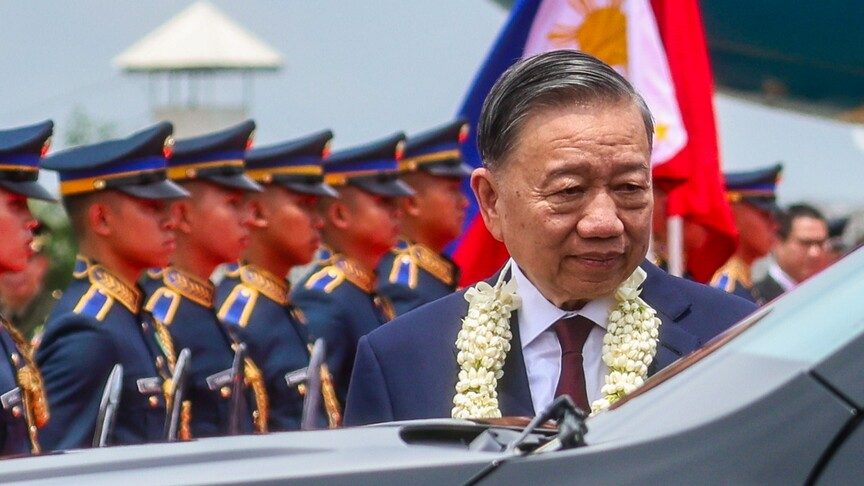
The agreement was reached in talks between visiting Vietnamese President To Lam and his Filipino counterpart Ferdinand Marcos Jr. in Manila, a joint statement said.
To Lam, who is also the general secretary of the Central Committee of the Communist Party of Vietnam, arrived in Manila on his maiden state visit on Sunday.
His visit marked the 50th anniversary of the establishment of diplomatic relations and a decade of strategic partnership between the two countries.
The two sides agreed to enhance existing maritime cooperation mechanisms, including the implementation of the “understanding on incident prevention and management” in the disputed South China Sea, as well as cooperation between their coast guards.
They also committed to resolving maritime incidents through peaceful and amicable means in accordance with international law.
The two presidents expressed their determination to build upon the gains of the current program of political-security cooperation, maritime safety and security collaboration, marine environmental protection, trade and investment expansion, agricultural exchanges, education, tourism, as well as cultural and people-to-people exchanges.
Both sides expressed their desire to surpass the $10 billion dollars bilateral trade target and attain a balanced trade relationship through the expansion of two-way trade opportunities, improvement of market access, and reduction of trade and investment barriers.
They expressed commitment to pursuing “closer” agricultural collaboration through joint research and development, and the exploration of potential areas for cooperation in trade and investment, particularly in agriculture, including rice, fisheries, sustainable blue economy development, sustainable agriculture, smart agriculture, disaster management, and climate change adaptation.
The two sides also called for closer bilateral cooperation to combat illegal, unreported and unregulated fishing through information sharing, capacity building, and cooperation in fisheries management and law enforcement.
Later, the two leaders witnessed the exchange of several bilateral agreements.



