ISTANBUL
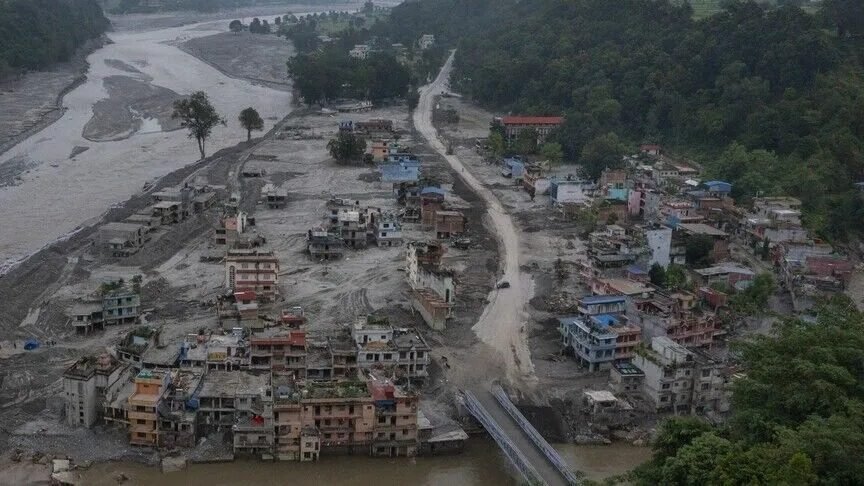
A group of expert academics said Thursday that climate change was “a destabilizing factor acting on a pre-existing geological predisposition” behind last month’s deadly flash floods and mudslides along the Nepal-China border.
In a report, World Weather Attribution, including researchers from Nepal, Pakistan, the UK, Ireland, Sweden, Denmark, Norway, the US, New Zealand and the Netherlands, including experts in glaciology, climate science, humanitarian aid, seismology, and social science, examined the range of factors that contributed to the disaster, which killed over 1,400 people, with over 6,000 still missing, according to the latest figures.
“Climate change is thus best understood as a destabilising factor acting on a pre-existing geological predisposition, rather than the fundamental cause of the failure,” the report said.
Although Nepal had early warning systems and adaptation measures, the incident “was beyond the design and predictive limits of existing risk reduction measures, and no existing early warning system could have provided sufficient lead time or prevented the scale of impacts observed in the worst-affected areas, highlighting the limits of adaptation,” it said.
The disaster struck on Aug. 26 when a glacier on Nepal’s Mount Langtang Lirung fractured at an altitude of 5,200 meters (17,060 feet).
The fracture triggered an ice-rock avalanche that turned into a massive debris flow and swept through valleys along the border.
Floodwaters and mudslides devastated Nepal’s Rasuwa, Nuwakot, Dhading and Kavre districts, as well as the Kathmandu Valley.
The disaster also buried the Gyirong border crossing in Xizang.
According to the report, the fracture may have been preconditioned by a magnitude 7.8 earthquake in 2015, while warming, permafrost degradation, glacier thinning and retreat, increased rainfall, and unusually warm conditions likely contributed to the incident eventually occurring.
“Rapidly rising temperatures at a rate beyond the global mean as a result of fossil fuel emissions increase the likelihood and severity of such hazards in the Himalayas,” it said.
The report called for stronger adaptation measures, including improved high-Himalaya earth observation, hazard monitoring, risk communication, and transboundary data sharing, as well as a rapid transition away from fossil fuels and delivery of climate finance commitments to reduce future risks.