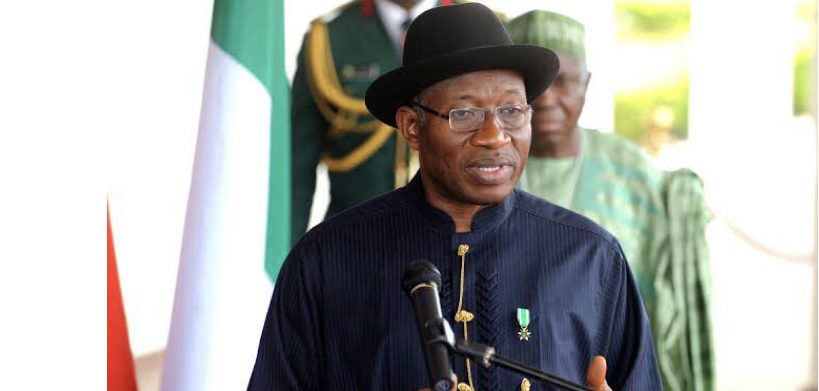
The Federal High Court, Abuja Division, on Tuesday adjourned hearing until May 8 a suit seeking to restrain ex-President Goodluck Jonathan from contesting the 2027 presidential election.
The matter, scheduled for mention on the day’s cause list, was fixed for hearing by Justice Peter Life.
Mr Life also ordered that hearing notices be issued and served on the defendants, who had yet to file their counter-affidavits, before the hearing date.
A lawyer, Johnmary Jideobi, filed the case, praying the court to bar Jonathan from contesting presidency in 2027.
Citing constitutional grounds, Mr Jideobi urged the court to issue an order of perpetual injunction, restraining Jonathan from presenting himself to any political party in the country for the purpose of contesting the poll.
He also urged the court to restrain the Independent National Electoral Commission (INEC) from accepting Mr Jonathan’s name from any political party or publishing the same as a duly nominated candidate for the election.
Mr Jideobi, in the suit marked FHC/ABJ/CS/2102/2025, sued the former president as the 1st defendant.
In the suit dated and filed on October 6, 2025, the lawyer joined INEC and the Attorney-General of the Federation (AGF) as the 2nd and 3rd defendants, respectively.
He sought one question for determination, which is:
“Whether in view of the combined provisions of the entirety of Sections 1(1), (2) & (3) and 137(3) of the 1999 Constitution of the Federal Republic of Nigeria as amended and their conflated interpretation, the 1st defendant is eligible, under any circumstances [whatsoever], to contest for the office of the President of the Federal Republic of Nigeria?”
Citing Sections 1(1), (2) & (3) and 137(3) of the 1999 Constitution of the Federal Republic of Nigeria as amended, he argued that INEC lacks the constitutional power to receive from any political party the name of Mr Jonathan for election into the office of the president of the Federal Republic of Nigeria, to be held in 2027 and other years to come.
As well as “an order of this Honourable Court directing the 3rd defendant (AGF) to ensure compliance with the decisions and orders of this court.”
In an affidavit of facts that was deposed in support of the suit by one Emmanuel Agida, the plaintiff told the court that he is an advocate of constitutionalism and the rule of law.
He told the court that the 1st defendant was first sworn in as president on May 6, 2010, following the death of the then-President Umaru Musa Yar’Adua on May 5, 2010, having previously been the vice-president.
He said he recently saw, on various national dailies and television stations, reports on Jonathan’s intention to contest presidency in 2027.
“That the plaintiff believes that the 1st defendant, having completed the unexpired term of late President Yar’Adua and subsequently served a full term after the 2011 election, has exhausted the constitutional limit of two tenures as president.
“That if the court does not intervene timeously, a political party may present the 1st defendant as its presidential candidate in the 2027 general election, thereby breaching the constitution,” he said.
On his locus standi (legal right) to institute the action, the plaintiff maintained that part of his duties, as a lawyer, is to forestall a violation of the constitution and to uphold the rule of law.
“There are chances that one of the political parties in Nigeria may favour the 1st defendant to stand as its presidential candidate in the forthcoming 2027 general elections to be conducted and overseen by the 2nd defendant. If unchallenged, the 1st defendant may enter the 2027 presidential race on the platform of one of the political parties in Nigeria and may possibly emerge the winner of the said election.
“In the event the 1st defendant is returned as elected and sworn as the president of the Federal Republic of Nigeria in 2027, it will mark the 3rd time the 1st defendant will be taking the oath of office as the president of the Federal Republic of Nigeria.
“In the event the 1st defendant is returned as elected and sworn as the president of the Federal Republic of Nigeria in 2027, the plaintiff, as a Nigerian citizen, would become one of those under the governance control of the 1st defendant [who by virtue of his office would be saddled with the responsibility of executing the laws of the country].
“As a Nigerian lawyer trained in Nigerian constitutional law, the plaintiff has come across a provision in the Nigerian constitution stating that a person who was sworn in as president to complete the term for which another person was elected as president shall not be elected to such office for more than a single term. The plaintiff knows that the 1st defendant was indeed, on the 6th of May, 2010, sworn in as president to complete the term for which (former) president Umaru Musa Yar’Adua was elected as president as a consequence of the demise of the former president on the 5th day of May, 2010.
“The 1st defendant, after being sworn in on 6th May, 2010, to complete the term of the late Umaru Musa Yar’Adua, was subsequently elected into the office of the President of the Federal Republic of Nigeria and sworn in on the 27th May, 2011. I know that if the 1st defendant eventually wins the forthcoming 2027 general election as president of the Federal Republic of Nigeria (which is for a term of four years spanning 2027 to 2031), he will have exceeded 8 years, the cumulative maximum years a Nigerian president is to stay in office.
“The plaintiff has instituted this suit in the public interest, in the defence of the rule of law and accentuation of the supremacy of the Constitution, and to preserve the integrity of the Nigerian constitutional order. It will be in the interest of justice for this Honourable Court to grant the prayers contained on the face of this Originating Summons,” the affidavit read.
(NAN)