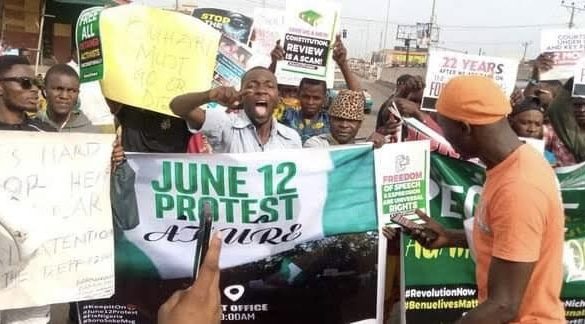
Thirty-two years ago, millions of Nigerians, regardless of religion, ethnicity, status and other differences, united to collectively confront the military regime, demanding a return to democratic rule, even at the expense of their lives and personal comfort.
The June 12, 1993, election was like no other election in Nigeria as citizens, with high expectations, marched to the polls across the nation to decide who would lead the country, 10 years after the military coup d’état that ousted democratically elected President Shehu Shagari, truncated the Second Republic, and ushered in the Muhammadu Buhari regime in 1983.
It’s annulment by the General Ibrahim Babangida, a military dictator, rechristened “Maradonna” for his schemings to prolong military rule and delaying Nigeria’s return to democracy, triggered mass mobilisation for years of vehement opposition to oppressive military rule that saw some exiled, some jailed, some brutalised and killed.
While Moshood Abiola, the presumed winner of the June 12 election, his wife, Kudirat Abiola, Alfred Rewane, Bagauda Kaltho and many others died in the struggles, fearless Nigerians, including university students, activists, lawyers, journalists, members of civil societies, sustained the struggle until democratic rule was restored in the country in 1999.
Gani Fawehinmi, Anthony Enahoro, Dan Suleiman, Abraham Adesanya, Ayo Adebanjo, Balarabe Musa, Ganiyu Dawodu, Ndubuisi Kanu and many others were prominent pro-democracy actors who have died. However, among those who are still alive, some have transitioned into mainstream politics, some remain journalists and activists, while others have retired to their professions.
On this year’s June 12, Nigeria’s Democracy Day, Peoples Gazette highlights reflections from some of these pro-democracy activists, 32 years after they risked their lives to confront a military junta and demand democratic rule.
Upon serving as senator representing Lagos West in 1993 and a two-term governor of Lagos from 1999 to 2007, Bola Tinubu, 74, an ally of Mr Abiola, a prominent member of the National Democratic Coalition, a pro-democracy group formed on May 15, 1994, with Nigeria’s return to democracy as its core objective, emerged as Nigerian president some 29 years after the June 12 struggle.
Though accused of destabilising opposition political parties, Mr Tinubu, in his 2025 Democracy Day speech, said, “We must be vigilant in expanding the political space. We must always value dialogue over dictatorship, persuasion over suppression and rights over might. Be tolerant and broad-minded in your legislative action regarding speech and civil liberties.”
Mr Tinubu is seeking a second term as president.
Femi Falana
Femi Falana, a human rights lawyer, alongside others, played a crucial role in the June 12 struggle, which led to Nigeria’s return to democracy in 1999. Aside from being part of those marching on the streets of Lagos, demanding an end to military rule, Mr Falana offered free legal services to other pro-democracy activists jailed by the military regime.
Ahead of this year’s June 12 commemoration, Mr Falana, in collaboration with other civil society groups, declared nationwide protests over rising insecurity, poverty and increased attacks on free speech in Nigeria’s democracy.
“Nigerian people deserve a pro-people government that places protection of lives and property at the core of governance. For years, Nigerians have been told that insecurity is being defeated. Yet killings continue. Communities are attacked, schools are threatened, farmers cannot safely access their farms, highways remain unsafe, and families continue to live with the pain of losing loved ones or having relatives in captivity,” Mr Falana said.
Mr Falana is still practising law in Nigeria with an eye on politics.
Kayode Fayemi
Famous for leading Radio Kudirat, a guerrilla-style pro-democracy radio that challenged the repressive military regime of General Sani Abacha in exile, Kayode Fayemi, after Nigeria returned to democratic rule, served as Ekiti State governor for two terms. He was also a former minister of solid minerals from 2015 to 2018.
Speaking about Nigeria’s democracy recently, Mr Fayemi, 61, who now heads The Amandla Institute, a pan-African leadership and policy advancement not-for-profit organisation, said, “What we mustn’t do is to conflate elections with democracy. What we got was to re-establish the right to vote our leaders into office in 1999. What we are yet to get is real democracy, in my view. We got civilian rule, we are proudly on the journey — we now have a semi-democracy, but we don’t have full democracy.”
Omoyele Sowore
Omoyele Sowore, a student union leader at the University of Lagos between 1992 and 1994, was a prominent figure among young Nigerians who mobilised students for various pro-democracy protests before and after June 12. For this, he was expelled twice but later reinstated.
“The democracy we practice has absolutely not met expectations. The democracy we suffered for was one that is inclusive, promoting credible and fair elections and a system that would bring about a new lease of life after a brutal military regime. All of these have not been achieved by those who inherited the democratic process since 1999,” Mr Sowore told The Gazette. “It was a struggle for a better and working Nigeria. But we are still suffering to date.”
Mr Sowore remains an activist. He has also become a politician and is the publisher of Sahara Reporters.
He will be running for president in 2027.
Senator Shehu Sani
Shehu Sani was a student activist at Kaduna Polytechnic during the military era and was among the pro-democracy crusaders detained in 1993 by the Ibrahim Babangida regime for demonstrating to demand that Abiola be declared the winner of the June 12, 1993, election. In 2015, Mr Sani was elected to represent Kaduna Central in the Senate. He is also the All Progressives Congress senatorial candidate for 2027.
Speaking on June 12, 2025, in a post on X, Mr Shehu said, “There is so much hardship and hunger in the land. The earlier the reforms bear fruit and end the aggravating poverty in the land, the better, safer and more peaceful our country will become. We have come a long way, but we also have a long way to go. Democracy should not be a Government installed by the majority for the benefit of a minority. We should not despair, but continue to work for a better country.”
Once a senator, Mr Sani wants to serve again in 2027.
Abdul Mahmud
Abdul Mahmud, 57, now a lawyer and president of the Public Interest Lawyers League, was one of the radical leaders of the Nigerian Association of Nigerian Students in the 90s, arrested and detained alongside other students by the State Security Service for their involvement in the June 12 struggle under the repressive military junta.
“I would rate Nigeria’s democracy as a work in progress: resilient, but still far from the democratic ideals that inspired many of us to confront military rule. June 12 was not merely a struggle to replace soldiers with civilians. It was a struggle for popular sovereignty, accountable governance, the rule of law, and a political order in which the votes and voices of ordinary Nigerians would matter, Mr Mahmud said.
Olarenwaju Arogundade
Olarenwaju Arogundade
Olarenwaju Arogundade, the executive director of the International Press Centre, was involved in pro-democracy activism on two fronts. First, as president of the National Association of Nigerian Students in 1983/1984, he mobilised opposition to the military regime’s austerity policy, which ended food subsidies in federal universities nationwide.
Secondly, as editor of Mr Abiola’s National Concord newspaper, Mr Arogundade was criticising and mounting pressure on successive military regimes. Mr was among the pro-democracy actors on the national security watch list. His name was recently removed from the list in 2025.
“(June 12’s) expectations have not been largely met, because the struggle was for democracy. A struggle against a system in which a group of people, the military, can just decide that the views of the majority in the society do not matter. They can just do what they like. But even in our civilian democracy, successive ruling classes have adopted an attitude suggesting they can do whatever they like. They can violate citizens’ rights. They can criminalise protests and so on. It is an embarrassing development when you put it in the context of what democracy should represent,” Mr Arogundade told The Gazette.
“If you also look at June 12 from Abiola’s campaign, he ran a campaign on the basis of farewell to poverty that resonated with the 14 million Nigerians who voted for him in the election. If you look back to that time and what is happening now, and ask whether there has been a farewell to poverty,” Mr Arogundade explained. “From what we are experiencing, it is more like welcome to poverty with the majority of our people. This poverty is fueling a lot of criminality. That’s why corruption is permeating every level of our society. So if you look at our expectation, then during the June 12 struggle and where we are now, you will see why I said they have not been largely met.”
He admitted that “we have not even perfected our electoral process since then”.
“But,” said Mr Arogundade, “when you look at the conduct of the June 12 election, it was regarded as the freest and fairest election. No incidence of violence. Nobody attacked anybody. Everything went peacefully. But then look at the elections we have had after that. That of 2007 was so bad that the declared winner, late Umaru Musa Yar’Adua, admitted that he was a product of a completely flawed election.”
Mr Arogundade continues to pursue his passion for public accountability and consciousness.
Osa Director
A lawyer and investigative journalist with Tell Magazine, a platform known for its guerrilla-style journalism, Osa Director, also suffered incessant persecution for practising adversarial journalism confronting the Abacha-led regime.
“As a June 12 pro-democracy activist, I cannot say I’m proud of the democratic development and evolution in Nigeria. It would appear as though all the risk we took is going down the drain because democracy seems to be in reverse gear. Where those who are elected to espouse and deepen the tentacles of democracy and the rule of law, and those who move to subvert the democratic process. Im not happy.
“I thought we should have gone beyond this stage. You cannot describe Nigeria as a democratic state. It is perhaps a civilian state, where you have periodic elections but tenets of democracy are still lacking over 20 years down the line,” Mr Director said.
He is now the spokesperson for the Nigeria Democratic Congress.