NAIROBI
Kenya’s Health Minister Aden Duale on Tuesday apologized to the High Court and denied deliberately defying court orders in a case involving a controversial US-backed Ebola quarantine facility, arguing that any non-compliance stemmed from a misunderstanding rather than an attempt to undermine the judiciary.
Appearing before High Court Judge Patricia Nyaundi for mitigation after being found in contempt of court, Duale said both the Health Ministry and the government remained committed to the rule of law and respect for judicial authority.
The hearing marked a rare court appearance by a sitting Kenyan Cabinet minister facing possible sanctions for contempt of court, underscoring the growing legal and political stakes surrounding the disputed facility.
The minister was found in contempt on Monday after the court ruled that he allowed work to continue on a planned 50-bed quarantine and isolation facility at Laikipia Air Base despite orders suspending the project.
“I find that in commissioning the ongoing construction of the facility at Laikipia, the 2nd respondent (Health Cabinet Secretary Aden Duale) is in continuing contempt of the orders of the court that were issued on May 28, 2026, and confirmed on June 2, 2026,” the judge ruled.
The facility at the center of the dispute is located at Laikipia Air Base, about 8 kilometers (5 miles) west-northwest of Nanyuki and roughly 200 kilometers (124 miles) north of Nairobi. It was intended to accommodate Americans potentially exposed to Ebola during response operations in the Democratic Republic of Congo and other affected countries in the region.
Duale told the court that government actions had been guided by scientific advice and public health considerations amid the ongoing outbreak.
He argued that Kenyan and US authorities suspended the proposed collaboration after conservatory orders were issued and that officials understood the court’s directives to apply to the implementation of the bilateral arrangement rather than broader preparedness measures.
The health minister also defended the need for isolation facilities, citing the risk posed by Kenyan peacekeepers serving in eastern Congo under UN missions and other travelers arriving from Ebola-affected areas.
Duale said he advised President William Ruto against traveling to a conference in Congo-Brazzaville in May because of Ebola-related health concerns and that the president subsequently delivered his remarks virtually.
According to the minister, members of a presidential advance team that had traveled to Congo-Brazzaville were quarantined for 21 days upon returning to Kenya.
Duale also told the court that he had directed the cessation of any intended construction, site preparation, or related activities at the Laikipia facility pending the hearing and determination of the substantive petition.
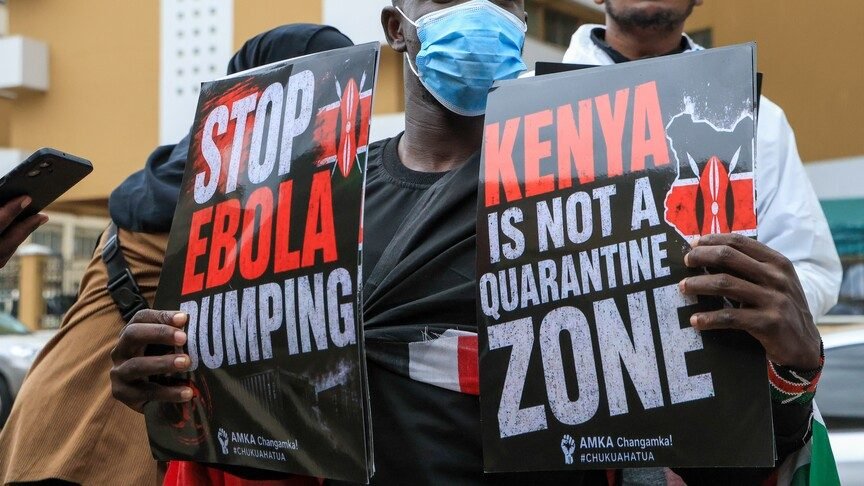
The project has become one of Kenya’s most contentious public health initiatives, drawing legal challenges, protests, and criticism from opposition politicians, civil society groups, and local leaders.
The controversy deepened after Ruto disclosed that he approved the facility following a request from his US counterpart Donald Trump, describing the arrangement as part of a long-standing health partnership between Kenya and the US.
The legal dispute has unfolded alongside demonstrations in Laikipia County, where protesters have opposed the project and accused authorities of disregarding both public concerns and court directives. At least three people have been killed during protests linked to the facility, according to police, witnesses, and rights groups.