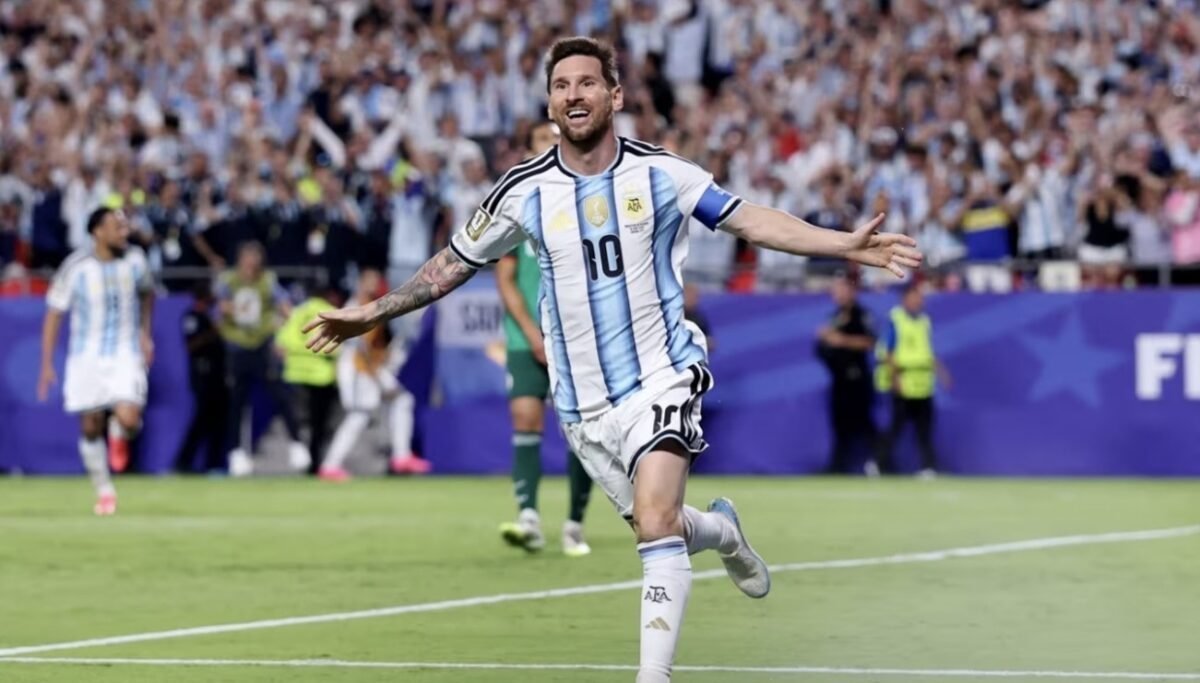
FIFA has confirmed that a hat-trick by Argentina star Lionel Messi in Wednesday’s victory over Algeria has made him a joint all-time World Cup scorer, a record previously held solely by retired Germany international Miroslav Klose in 2014.
The world football governing body disclosed this in an updated list of the current all-time top scorers since the inception of the World Cup in 1930.
Messi is on course to break and even extend the record at the ongoing 2026 edition, co-hosted by the U.S., Canada and Mexico, with two matches left in the preliminary stage of Group J and five more to play if Argentina progress to the knockout phases and through to the final.
Currently, Messi has 16 goals in 27 matches, with six World Cup appearances: 2006 (one goal), 2010 (no goals), 2014 (four goals), 2018 (one goal), 2022 (seven goals), and 2026 (three goals to date).
However, Klose achieved their feat in 2014 with fewer World Cup appearances and fewer matches played.
The German had 16 goals in 24 matches after four World Cup appearances: 2002 (five goals), 2006 (five goals), 2010 (four goals), and 2014 (two goals).
Others on the list include former Brazil striker Ronaldo, who bagged 15 goals in 19 matches across four World Cup appearances: 1998 (four goals), 2002 (eight goals), and 2006 (three goals).
Germany’s Gerd Muller scored 14 goals in 13 matches across two World Cup appearances: 1970 (10 goals) and 1974 (four goals).
France’s Kylian Mbappe has scored 14 goals in 15 matches across three World Cups: 2018 (four goals), 2022 (eight goals), and 2026 (two goals to date). He also has a chance to equal and break the 16-goal record at the ongoing tournament.
France’s Just Fontaine scored 13 goals in just six matches in only one World Cup participation in the 1958 edition.
Brazil’s Pelé Nascimento bagged 12 goals in 14 matches across four World Cup appearances: 1958 (six goals), 1962 (one goal), 1966 (one goal), and 1970 (four goals).
Jurgen Klinsmann of West Germany scored 11 goals in 17 matches across three World Cups: 1990 (three goals), 1994 (five goals), and 1998 (three goals).
Hungary’s Sandor Kocsis played five matches at a single World Cup in 1954 and scored 11 goals.
Argentina’s Gabriel Batistuta scored 10 goals in three World Cup appearances: 1994 (four goals), 1998 (five goals), and 2002 (one goal).