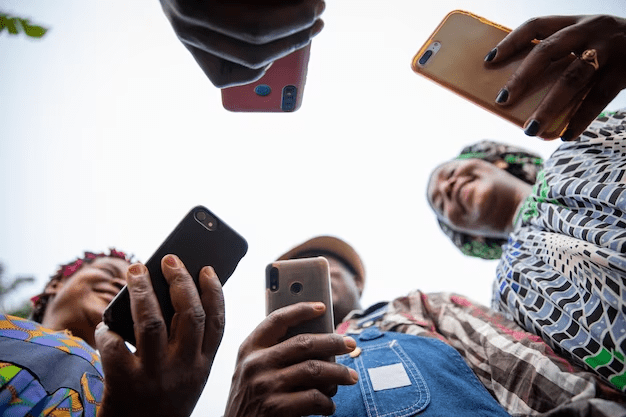
The rise in smartphone use between 2007 and 2024 has been associated with declining fertility rates among women of reproductive age globally during the same period, according to new studies.
In a study titled, “The Collapse of Teen Fertility in the Digital Era,” economists Nathan Hudson and Hernan Moscoso Boedo of the University of Cincinnati examined the “striking fact” of a sharp reduction in teen fertility across 128 countries beginning in 2007.
The study, published in April, suggests that the spread of smartphones may have triggered a “tipping point” as teenagers shifted from in-person interaction to phone-based communication.
It notes that the trend appears across countries with different social, economic, and policy environments.
It also finds that, alongside the rise of digital technology, in-person socialising declined sharply—a shift the authors link to changes in teen fertility, sexual activity, mental health outcomes, suicide rates, and crime.
The study suggests the fertility rate fell sharply around 2008 among teens aged between 15 and 19 in high-income countries, declined modestly among those aged between 20 and 24, and showed little or no change among 25-year-olds and older, who account for about 80 per cent of the reproductive-age population.
The authors argue that teen birth rates declined as smartphone prices fell. In the U.S., the birth rate among girls aged between 15 and19 fell by 71 per cent; by 43 per cent among those aged 20–24; by 23 per cent among those aged 25–29; by one per cent among those aged 30–34; and by nine per cent among those aged 35–39 over the period under review.
The findings suggest that the decline was not driven by delayed childbearing or an increase in abortions, but by fewer conceptions linked to reduced in-person socialising among teenagers.
“Within the United States, terrain ruggedness variation in broadband and 4G coverage identifies a causal effect on teen fertility, and time-use diaries show in-person socialising among teens roughly halving while digital leisure roughly tripled,” the authors said.
A second study by economists Caitlin K. Myers and Ezekiel Hooper, titled, “Is the iPhone Birth Control? Causal Evidence from AT&T’s 2007–2011 Carrier Monopoly,” also suggests that the introduction of the iPhone might have accounted for a substantial decline in fertility during that period, primarily through the reduction of face-to-face interaction.
The study uses AT&T mobile broadband coverage, birth records from the National Center for Health Statistics (NCHS), and county-level data by age, race, education, marital status, and parity.
“U.S. births are plummeting,” the authors said, noting that births remained stable at 65 to 70 per 1,000 between 1980 and 2007 before declining sharply from 2007, the trend that continued through the recovery from the Great Recession, the COVID period, and into the 2020s.
“The decline continued through the long economic expansion of 2010–2019, through the COVID dip and its aftermath, with declines visible across the same subgroup,” the study said.
Birth rates fell sharply among teenagers by 70 per cent, and by 47 per cent among those aged 20–24, but only by seven per cent among those aged 30–34, while rates at 35–39 actually rose by 14 per cent.
The findings identified the iPhone—launched in 2007—and social media as “exogenous shocks that changed major facets of work and socialising across cohorts,” including reduced time dating, drinking and driving; lower participation in paid work; fewer sexual partners; and increased sexual inactivity among young adults.
The authors estimate that the iPhone might have accounted for a 21–31 per cent decline in teen births between 2007 and 2011, about 14–40 per cent among women aged 20–24, and 21–25 per cent among women aged 25–29.
They estimate that, of the 6.2 births per 1,000 women, roughly 2.1 to 3.2 births per 1,000 likely attributable to the iPhone during that period, reflecting a decline in the general fertility rate.
The studies suggest that smartphones may have contributed to reduced fertility primarily through changes in social behaviour, particularly reduced in-person interaction and changes in sexual activity.