
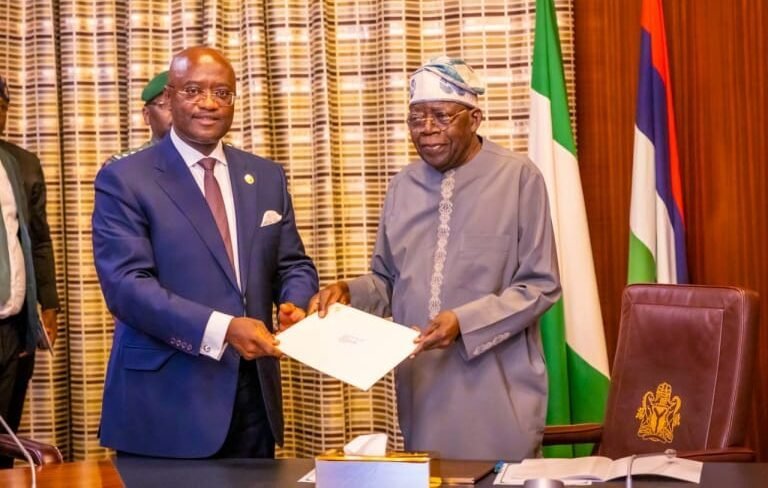
President Bola Tinubu on Tuesday urged the leadership of the African Export-Import Bank to leverage Africa’s human, financial and natural resources to promote economic progress for all Africans.
Mr Tinubu made the call on Tuesday while receiving a delegation from Afreximbank, led by its president and board chairman, George Elombi, at the State House in Abuja.
A statement on Tuesday by the president’s spokesperson, Bayo Onanuga, said Mr Tinubu told the delegation that his administration’s recent economic reforms—including the removal of the fuel subsidy and the unification of the foreign exchange market—were necessary moves to curb corruption and secure the country’s economic future.
Mr Tinubu, who referenced Africa’s natural endowments, called for a transition from “endless conversations” to concrete measures to accelerate industrialisation and intra-African trade, create jobs, promote value addition, and raise the standard of living across the continent.
Commenting on the trend of farmer-herder clashes in Nigeria, the president said his administration turned the longstanding conflict between farmers and herders into an economic opportunity for citizens by establishing the Federal Ministry of Livestock Development.
Mr Tinubu said, “I created the Livestock Ministry to create economic opportunities for Africans. The cotton, ginnery and garment industries are job creators. If we partner well and incorporate these ideas and do less talking and really put our heads into developmental programmes, we can turn it around.”
He urged Afreximbank’s management to partner with the Bank of Agriculture, invest more in the production of crops such as cocoa, palm kernel, and palm oil, and ensure that agricultural value chains deliver lasting benefits.
Also speaking, the minister of state for industry, John Owan Enoh, described the president’s economic diversification policies as a transformative agenda aimed at repositioning Nigeria for sustainable economic growth, industrial expansion and shared prosperity.
“President Tinubu’s commitment to industrialisation, particularly through the development of the solid minerals sector, oil and gas, manufacturing, agriculture, the digital economy, and value-added exports, is laying the foundation for a resilient economy less dependent on crude oil revenues,” Mr Enoch said.
Mr Elombi, the board chairman of Afreximbank, said the visit was to thank the president for his support and brief him on the bank’s operations and investment portfolio in Nigeria.
He said the bank has been working to reverse medical tourism in Africa, stating that it has invested between $15 billion and $20 billion in the Nigerian economy over the past five years.
Mr Elombi disclosed that Afreximbank had also committed $2 billion to support Nigeria’s cotton and garment industry, adding the bank has also invested in the Lagos-Calabar Coastal Highway and the Kano-Maradi railway project.



