
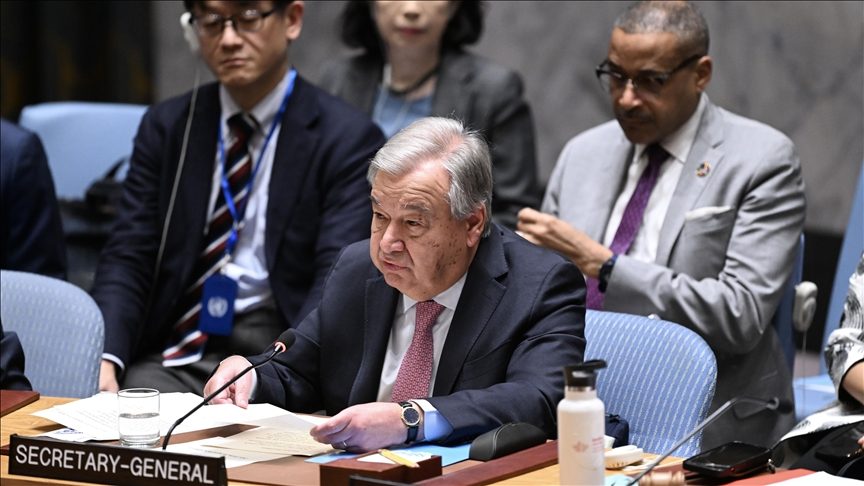
UN Secretary-General, Antonio Guterres, on Wednesday, announced a plan to help Nigeria turn mineral wealth into jobs and prosperity under a new Country Support Mechanism on Critical Energy Transition Minerals.
The mechanism will assist resource-rich developing countries in building sustainable, responsible and resilient mineral value chains, ensuring that the benefits reach the people and nations at the source of the transition.
Nigeria, Guinea, Indonesia, Madagascar, Zambia and Zimbabwe will be the first countries to receive dedicated support through the innovative new initiative.
Mr Guterres, in a statement, said that countries that hold the critical minerals powering the energy transition must be the first to benefit from them.
“With Nigeria, Guinea, Indonesia, Madagascar, Zambia and Zimbabwe as our first partners, the Country Support Mechanism puts equity and justice into practice to turn mineral wealth into jobs and prosperity at home.”
According to him, critical energy transition minerals are essential components in many of today’s fast-growing clean energy technologies and include copper, lithium, nickel, cobalt and rare earth elements.
He noted that the minerals are vital for manufacturing technologies such as wind turbines, solar panels, electric vehicles and battery storage systems.
“Demand for critical minerals is set to almost triple by 2030 as the world transitions from fossil fuels to renewable energy in order to reduce global carbon dioxide emissions to net zero by 2050.
“For developing countries endowed with these natural resources, rising demand presents an opportunity to diversify economies, strengthen value addition and industrial development, and create jobs.
“But without strong governance and responsible management, mineral extraction risks perpetuating commodity dependence, exacerbating geopolitical tensions, and saddling resource-rich communities with the environmental and human impacts without realising any of the benefits.”
In response, he said the United Nations had been working to strengthen international collaboration on critical minerals and foster trust among governments, local communities and industry.
He noted that the effort was aimed at addressing key concerns around equity, transparency, investment, sustainability and human rights.
Mr Guterres said the UN had also elevated the needs of resource-rich developing countries, which are now at the centre of a new global commodities race.
The United Nations is now scaling up support to help these countries tackle the challenges through a dedicated Country Support Mechanism.
The mechanism will provide coordinated technical and capacity-building assistance to ensure that the countries derive real and lasting benefits.
Under the leadership of the UN Development Programme (UNDP) and the UN Development Coordination Office, the Country Support Mechanism will coordinate and leverage UN system expertise into a single offer for developing countries.
“As one of the world’s leading lithium producers, Zimbabwe recognises that critical minerals are central to the global energy transition.
“That transition must deliver equitable benefits for resource-rich developing countries, including through greater value addition and participation across critical mineral value chains.
“We, therefore, applaud Secretary-General Guterres for advancing a Mechanism that will translate this principle into practice,” Prof. Amon Murwira, Minister of Foreign Affairs and International Trade of Zimbabwe, said.
Also, Mulambo Haimbe, Minister of Foreign Affairs and International Cooperation of Zambia, said the country had been a copper nation for decades and had been contributing to global industrial development and, increasingly, the clean energy and digital transitions.
“As demand for critical minerals grows, our ambition under the Grow Zambia Agenda is not simply to produce more, but to create greater value at home through investment, value addition, industrialisation and jobs.
“We want Zambians to be full participants, not simply suppliers to the global clean energy and technology transition. This requires strong governance, investment and partnerships that enable resource-rich countries to move up the value chain.
“We therefore welcome the Country Support Mechanism as an important initiative designed to support that ambition,’’ Mr Haimbe said.
“Critical minerals can help countries diversify and transform their economies. However, to turn mineral wealth into a true driver of development, countries need value creation, environmental protection and good governance to advance together.
“The UN Country Support Mechanism is designed to provide on-the-ground expertise to countries and help ensure that critical mineral wealth translates into stronger opportunities for people and communities” Alexander de Croo, Administrator of the United Nations Development Programme, said.
Reacting, Inger Andersen, Under-Secretary-General of the United Nations and Executive Director of the United Nations Environment Programme (UNEP), said critical minerals could unlock new pathways for sustainable development, but only if they were sourced responsibly.
“UNEP will actively contribute to the Country Support Mechanism to help countries protect environmental integrity, advance circularity, and support resilient livelihood opportunities,” she said.
Pedro Manuel Moreno, Deputy Secretary-General and Acting Secretary-General of the United Nations Conference on Trade and Development (UNCTAD), said the global economy had left resource-rich developing countries as raw material exporters rather than industrial partners for too long.
“The Country Support Mechanism is a concrete step toward changing that: helping countries build the value chains, governance frameworks and industrial capacity to become full participants in the clean energy economy,” Ms Moreno said.
The Country Support Mechanism is part of the broader effort of the UN Task Force on Critical Energy Transition Minerals.
It is co-led by the UN Development Programme, the United Nations Conference on Trade and Development and the United Nations Environment Programme.
The task force is coordinating UN system work to advance the recommendations of the secretary-general’s panel on critical energy transition Minerals and support their implementation.
The initiative aims to help countries harness their mineral resources to advance sustainable development, economic diversification and a just and equitable clean energy transition.
(NAN)



