ISTANBUL
- Economist Khaled al-Shafei expects canal to withstand renewed tensions due to geographic, economic advantages
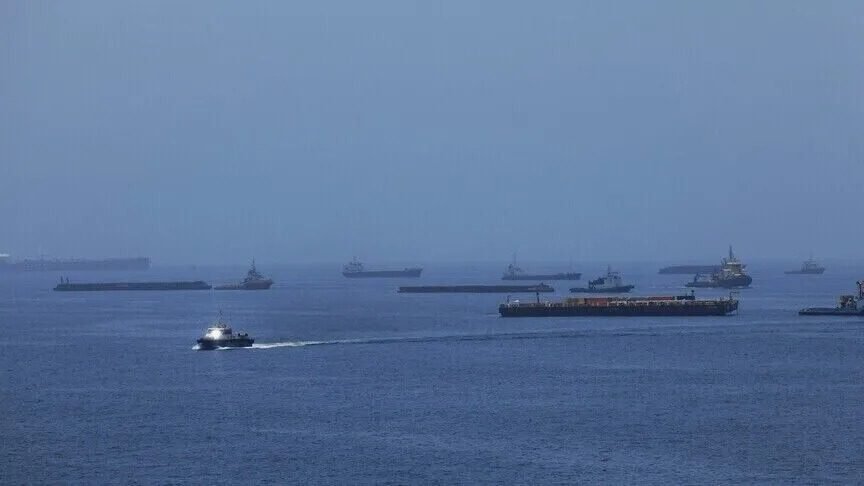
Nearly three years after tensions in Bab el-Mandeb disrupted shipping through the Red Sea and inflicted billions of dollars in losses on Egypt’s Suez Canal, renewed regional tensions are once again putting the strategic waterway to the test.
Yemen’s Houthi group threatened navigation through Bab el-Mandeb, the gateway from the Red Sea to Egypt’s Suez Canal and onward to the Mediterranean, nearly three years ago. At the time, Houthi attacks on ships in the Red Sea caused losses of around $11 billion to the canal, one of Egypt’s main sources of foreign currency, according to Egyptian officials.
The Houthis resumed targeting shipping in the Red Sea about two months ago, prompting Egyptian warnings over the repercussions of any disruption to international maritime routes, including the canal linking Asia and Europe.
Territorial control in Yemen has also shifted recently, with the Houthis advancing along the western coast and taking control of strategic areas, including Red Sea islands such as Mayyun Island in the Bab el-Mandeb Strait.
Tensions in the Red Sea and Gulf of Aden have escalated since July 20, when the Houthis announced a “maritime blockade” on vessels linked to Saudi Arabia in response to what they claim is a Saudi blockade on areas under their control in Yemen.
The Houthis have targeted oil tankers and Saudi vessels along regional shipping routes and attacked sites inside the kingdom, including civilian airports and energy production facilities, causing civilian casualties and material damage.
Saudi Arabia has led a coalition supporting Yemen’s internationally recognized government since 2015, while Iran is accused of backing the Houthis, who have controlled provinces and cities, including the capital Sanaa, since 2014.
Last week, Egypt and Saudi Arabia stressed the importance of ensuring freedom of navigation through the Strait of Hormuz, Bab el-Mandeb and the Red Sea following talks between Egyptian President Abdel Fattah el-Sisi and Saudi Crown Prince Mohammed bin Salman in Cairo.
Days earlier, Sisi called during a BRICS summit in India for safeguarding freedom of navigation through international waterways amid current developments, particularly as a significant share of global trade passes through the Red Sea and Suez Canal.
The Red Sea tension comes amid regional escalation following US and Israeli attacks on Iran in February, which responded with missile and drone strikes across the region. Tehran also effectively closed the Strait of Hormuz, a strategic route for energy supplies.
Strategic chokepoint
Egypt’s calls for calm and stability in Bab el-Mandeb stem from the passage’s position as a “strategic chokepoint” and from economic and strategic considerations directly affecting the country’s national security, logistics expert Nasreddine Bougashish told Anadolu.
“Any disruption in Bab el-Mandeb will immediately and automatically affect the Suez Canal, Egypt’s vital artery, as ships would divert away from the canal,” Bougashish said.
“This would mean a direct blow to canal revenues, which constitute a fundamental source of the country’s foreign currency,” he added.
“The situation in Bab el-Mandeb remains open to difficult scenarios, and growing pressure on the passage now threatens the efficiency of global supply chains and weighs directly on the economic resources of countries in the region, including Egypt,” Bougashish warned.
Cairo moved to reassure the public about the Suez Canal amid growing global concern over the escalating tensions in Bab el-Mandeb.
“The canal is safe, navigation is regular, its services are operating efficiently, and its pilots are at the highest levels of performance and readiness,” Suez Canal Authority Chairman Osama Rabie said during a World Maritime Day 2026 event, as cited in an authority statement on Sept. 20.
He said navigation through the canal saw 1,358 vessels transit in August, with a total net tonnage of 68.3 million tons and revenues of $567.1 million.
“Previous challenges directly affected global supply chains, with their repercussions extending to navigation through the Suez Canal,” Rabie said. “But these challenges demonstrated the canal’s importance in securing global supply chains, reinforced its leading global position and proved that there is no sustainable alternative route to the canal,” he added.
Rabie was referring to Houthi attacks on commercial vessels linked to Israel in the Red Sea and Bab el-Mandeb following the Gaza war in October 2023. The attacks prompted major shipping companies to reroute vessels around the Cape of Good Hope, causing around $11 billion in losses to the Suez Canal.
“The canal diversified its sources of income during the crisis by localizing the production of marine vessels, establishing partnerships with the private sector and introducing new maritime services,” Rabie said.
The assurances came as Danish shipping company Maersk and Germany’s Hapag-Lloyd announced in separate statements on Sept. 14 that four joint container services would resume passage through the Suez Canal instead of using the Cape of Good Hope route around South Africa.
Economic flexibility
The security tensions around Bab el-Mandeb following in 2023 placed financial pressure on the Suez Canal but did not undermine its operational structure, Khaled al-Shafei, head of the Capital Center for Economic Studies, told Anadolu.
“The canal withstood the crisis because it has the geographic and economic flexibility that ensures its continuity, limiting the losses to temporary financial impacts until security conditions stabilized,” al-Shafei said.
“The canal also offered incentives and discounts on transit fees and diversified maritime services as part of its efforts to address the crisis at the time,” he added.
“The decision by Maersk and Hapag-Lloyd to return to the Suez Canal reflected the importance of relying on the waterway,” al-Shafei said.
He expects the canal to “withstand again” because of its geographic and economic advantages, particularly as it normally handles around 12% of global trade and about 30% of global container traffic.
Al-Shafei did not rule out Egyptian mediation to end the maritime tensions, describing it as a possible option to prevent economic repercussions affecting Egypt, Saudi Arabia and other Red Sea countries.
Full-scale escalation
Maritime transport and logistics economist Ahmed al-Shami said risks continue to threaten Bab el-Mandeb.
“Their direct impact on the Suez Canal, however, remains limited so far as navigation through the canal continues to grow,” he told Anadolu.
“The current threats differ from previous tensions, particularly because the Houthis have identified Saudi vessels as their targets this time,” al-Shami said.
“However, the threat remains, and future developments will determine the extent of the impact on shipping,” he added.
“Continued attacks on vessels would force shipping companies to adjust their routes,” al-Shami warned.
“Maersk’s return to the Suez Canal reflects an economic assessment that passage through the waterway is more viable than sailing around the Cape of Good Hope,” he said.
“An expansion of Houthi attacks on vessels could lead to a full-scale military escalation affecting global trade, not just the Suez Canal, by as much as 25%-30%,” al-Shami warned.
“The Suez Canal is currently recording gradual growth in maritime traffic compared with the previous two years,” he added.
Al-Shami expects canal revenues to rise above $7.5 billion by the middle of next year, compared with less than $4 billion in 2024, while also not ruling out Egyptian mediation to contain the current crisis.